Neodent · Zirconia System

Neodent / Zi Ceramic

Metal-free zirconia implant for patients with metal sensitivity or demanding esthetic requirements. White ceramic body — invisible under thin tissue. No grey shadow. No metal.

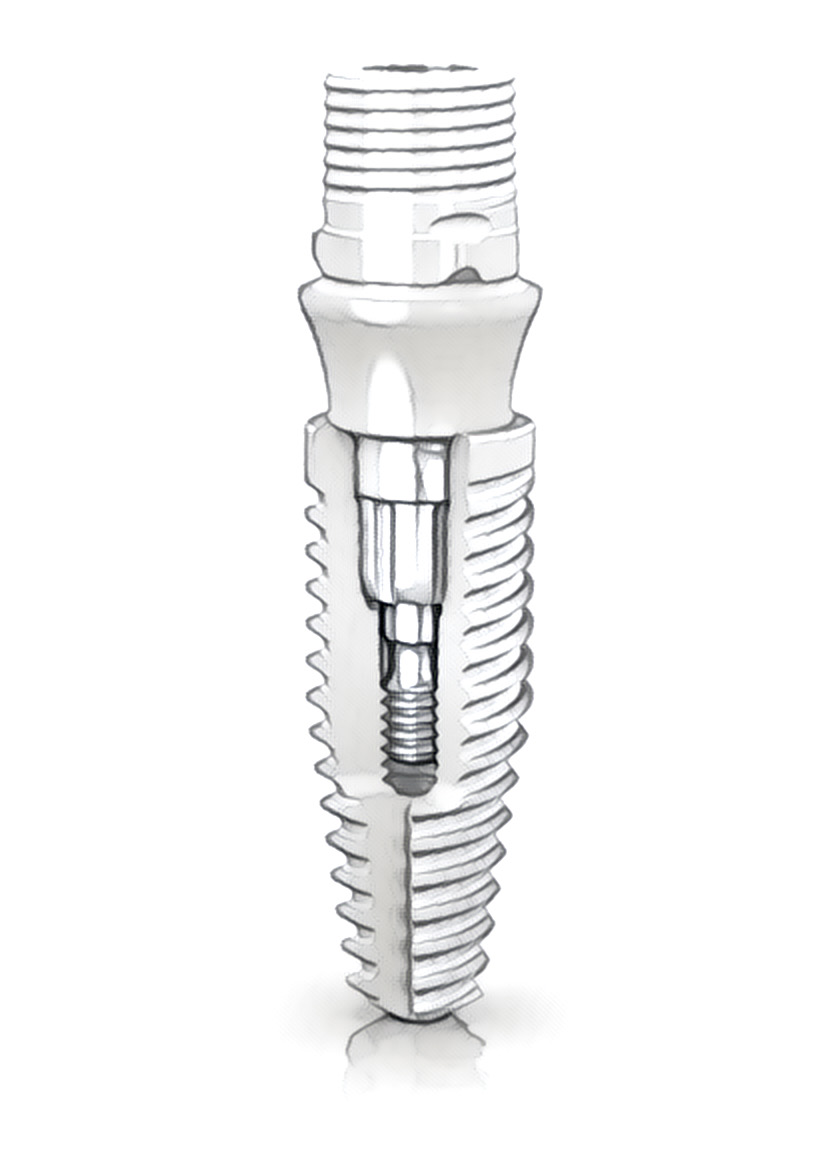
Zirconia Metal-Free Esthetic Zone White Ceramic Body Monotype Design Modified SLA Surface
Pricing
Available on request · Contact for current pricing and availability
Product
Zi Ceramic · One-Piece Zirconia · Metal-Free

Product Overview

MaterialY-TZP — Yttria-stabilized tetragonal zirconia polycrystal (5 mol% Y₂O₃)
DesignMonotype (one-piece) — implant body and abutment are a single milled unit; no internal connection
Surface TreatmentModified SLA on zirconia substrate — sandblasted with alumina + chemical etching for osseointegration
Cervical ZoneSmooth polished ceramic collar for soft tissue contact
DiametersØ 3.5 / 4.0 / 4.5 mm
Lengths10 / 12 / 14 mm
Prosthetic ConnectionNone — monotype design; crown is cemented or bonded directly to the ceramic abutment portion
Crown MaterialsZirconia (bonded), lithium disilicate (cemented), PMMA (provisional)
Loading ProtocolDelayed only — immediate loading not indicated due to ceramic brittleness under early load
Flexural Strength≥900 MPa — high strength, but lower fracture toughness vs titanium
BiocompatibilityExcellent — ISO 13356 certified; no metal ion release; no allergenic response
Primary IndicationMetal-free cases, esthetic zone, thin tissue biotype, confirmed metal sensitivity

What is the Neodent Zi Ceramic?

A fully metal-free implant solution for the growing subset of patients who require or prefer ceramic over titanium — without compromising osseointegration predictability.

The Neodent Zi Ceramic is Neodent's answer to the growing patient demand for metal-free dental restorations. While titanium implants carry a 50-plus-year clinical track record and remain the undisputed gold standard for implant dentistry, a distinct subset of patients presents with conditions or preferences that make zirconia the clinically superior or patient-preferred choice. These include patients with confirmed titanium sensitivity or allergy (a rare but documented phenomenon), patients with very thin peri-implant tissue biotype where the grey-metallic shadow of a titanium implant shows through the gingiva, and patients who hold a principled preference for metal-free materials — increasingly common in health-conscious demographics and in patients with systemic autoimmune concerns.

The Zi is manufactured from Y-TZP (Yttria-stabilized tetragonal zirconia polycrystal) — the same ceramic material used in high-load dental frameworks, fixed prostheses, and orthopedic implants. Y-TZP has a flexural strength exceeding 900 MPa and undergoes a phase transformation toughening mechanism (tetragonal to monoclinic) that resists crack propagation. Crucially for esthetics, zirconia is white — meaning it does not cast the grey-blue shadow through thin peri-implant mucosa that is a known and documented problem with titanium in the anterior zone. Patients with thin tissue biotype (Biotype I) in maxillary incisors or premolars are ideal Zi candidates precisely because even a perfect soft tissue result over a titanium implant may show through. The white zirconia body renders this concern clinically irrelevant.

The Zi uses a monotype (one-piece) design — a single milled unit where the implant body and the abutment are integrated without any internal connection, screw, or junction. This design choice is not aesthetic preference but engineering necessity: manufacturing a stable, reliable, and repeatedly torqued internal connection in zirconia presents significant material challenges — the stress concentrations at the junction could create fatigue fracture risk. The monotype design completely eliminates the implant-abutment microgap and the bacterial colonization, micromovement, and interface-level peri-implant inflammation that arises from it. This has favorable implications for long-term peri-implant tissue stability.

From a clinical osseointegration standpoint, multiple independent prospective studies and meta-analyses demonstrate that zirconia implants achieve osseointegration rates comparable to titanium, with 5-year survival rates consistently reported in the 95%+ range when proper patient selection and loading protocols are followed. The Zi surface is treated with a modified SLA process (sandblasting with alumina particles followed by chemical etching) adapted for the zirconia substrate — creating the micro-roughness topography required for osteoblast attachment and early bone formation. Bone-level integration quality in zirconia has been confirmed histologically in both animal and human studies, showing intimate bone-implant contact at the roughened surface zones.
What Makes the Zi Different

Six engineering and clinical advantages that define the Zi as the premium metal-free implant choice.

White Ceramic Body — No Grey Shadow
The white color of zirconia eliminates the grey-metallic shadow that titanium projects through thin peri-implant mucosa. In the anterior esthetic zone with biotype I tissue, this difference is visible and clinically significant — particularly for maxillary incisors and premolars.
🚫
Fully Metal-Free — No Ion Release
Zirconia releases no metal ions into peri-implant tissue. For patients with confirmed titanium sensitivity, autoimmune conditions, or a general preference for biocompatible metal-free materials, the Zi provides a fully ceramic solution from implant body to crown surface.
🧩
Monotype One-Piece Design
The implant body and abutment are a single integrated ceramic unit — no internal connection, no screw, no microgap. This eliminates the implant-abutment interface entirely, removing the primary source of bacterial infiltration and micromovement-driven marginal bone loss in conventional two-piece designs.
🧬
Modified SLA Zirconia Surface
A specially adapted sandblasting and acid-etching protocol creates the micro-rough topography needed for osteoblast adhesion and osseointegration on a zirconia substrate. The surface achieves bone-implant contact rates equivalent to SLA titanium in clinical and histological studies.
💪
High Flexural Strength — ≥900 MPa
Y-TZP offers exceptional flexural strength for a ceramic material — exceeding the requirements for anterior and premolar single-tooth applications. Transformation toughening at the crack tip resists fracture propagation. Correct indication selection (no bruxism, no molar position) keeps fracture risk minimal.
🦷
CAD/CAM Crown Compatibility
The ceramic abutment portion can be prepared chairside or by laboratory to receive a bonded ceramic crown. Full-contour monolithic zirconia crowns bonded with adhesive cement create a fully ceramic, metal-free restoration from implant apex to occlusal surface — the complete esthetic solution.

Patient Selection for the Zi Ceramic

Precise patient selection is more critical for the Zi than for any other implant in the Neodent line — indication adherence directly determines clinical success.

Ideal Indications

Confirmed Metal Sensitivity or Allergy

Patients with documented titanium sensitivity (patch testing, MELISA, or documented allergic response) where conventional titanium implants are contraindicated. Zirconia offers equal osseointegration without any metal ion exposure.

Thin Tissue Biotype in the Esthetic Zone

Biotype I patients with translucent thin tissue in maxillary anterior or premolar positions where the grey shadow of a titanium implant neck would be visible through the gingiva. The white zirconia body renders this problem non-existent.

Patient-Driven Metal-Free Preference

Health-conscious patients who request a fully metal-free restoration for philosophical, functional medicine, or wellness reasons. The Zi provides a clinically validated and scientifically sound response to this request.

Single-Tooth Anterior Replacement

Central incisors, lateral incisors, canines, and first premolars in standard bone volume — the Zi's size range (3.5–4.5 mm × 10–14 mm) is calibrated for these positions. Adequate bone volume and healthy soft tissue are prerequisites.

Contraindications and Limitations

Cases Where the Zi is Not Indicated

Bruxism (parafunctional) patients — cyclical high loads create cumulative ceramic fracture risk. The Zi is contraindicated in patients with active or uncontrolled bruxism.
Molar positions — posterior occlusal forces exceed the reliable load range for ceramic implants. Use titanium for first and second molar replacement.
All-on-4 or implant-retained overdenture cases — the Zi monotype design is not compatible with bar frameworks or MUA-based full-arch prosthetics.
Immediate loading — early occlusal loading during the osseointegration phase risks ceramic fatigue. A delayed protocol is mandatory for all Zi placements.
Cases requiring post-placement angulation correction — the monotype design locks in the abutment angle at insertion. The final crown angle must be planned and accepted before placement.

Surgical and Prosthetic Workflow

The monotype design requires a specific planning sequence — the prosthetic outcome must be mapped before implant placement.

1

Pre-Operative Planning — Backward from the Crown

Because the abutment angle is fixed at insertion, all prosthetic planning must precede surgery. Use CBCT and digital wax-up (or diagnostic stent) to confirm the ideal implant axis, which simultaneously defines the abutment angle of the delivered crown. If the required angle differs from available Zi configurations, titanium with an angled abutment may be more appropriate.

2

Surgical Placement — Gentle Protocol

Prepare the osteotomy with copious irrigation. Zirconia is sensitive to thermal stress — avoid dry drilling. Insert the Zi at controlled speed and torque. Avoid over-tightening — the monotype body transmits torque directly to the ceramic. Confirm the abutment angle matches the pre-planned prosthetic axis before the implant is fully seated. Once seated, the angle is locked in permanently.

3

Healing Phase — Submerged or Trans-Mucosal

Place a protective cap or PMMA provisional crown in occlusal clearance (out of contact) for the 8–12 week osseointegration period. No functional load is applied to the implant during this phase. The ceramic surface requires adequate time for bone apposition — delayed loading is not optional, it is a clinical requirement for fracture risk management.

4

Impression and Crown Fabrication

After confirmed osseointegration, take a digital intraoral scan or conventional impression. The ceramic abutment portion can be prepared (reduced) at chairside with fine-grit diamond burs and copious water cooling if angulation or emergence profile adjustment is needed. The laboratory mills or presses the final ceramic crown — monolithic zirconia for posterior, lithium disilicate for maximum esthetic result anteriorly — to bond to the prepared ceramic abutment.

5

Crown Delivery — Bonded or Cemented

Clean and dry the ceramic abutment surface. Apply adhesive bonding system (HF etch + silane primer + adhesive cement) for zirconia-to-zirconia bonding, or conventional glass-ionomer/resin cement for lithium disilicate crowns. Seat and light-cure. Verify occlusal contacts — ensure light contact in centric, no lateral excursive load on the implant crown in parafunctional movements. Take a periapical radiograph to confirm marginal fit and bone level at delivery.

Available Diameters and Lengths

Nine combinations across 3 diameters and 3 lengths — all in Y-TZP zirconia with modified SLA surface and monotype design.

Ø 3.5
Narrow · Lateral Incisor
Ø 4.0
Standard · Central / PM
Ø 4.5
Wide · Thick Bone Zones
10 mm
Short · Limited Height
12 mm
Standard · Most Sites
14 mm
Long · Maximum Stability
Configuration Diameter Length Typical Indication
Ø 3.5 × 10 mm3.5 mm10 mmNarrow ridge lateral incisor with reduced bone height
Ø 3.5 × 12 mm3.5 mm12 mmNarrow ridge lateral incisor — standard length
Ø 3.5 × 14 mm3.5 mm14 mmNarrow ridge sites with adequate bone height for maximum stability
Ø 4.0 × 10 mm4.0 mm10 mmCentral incisor or premolar with limited vertical bone
Ø 4.0 × 12 mm4.0 mm12 mmCentral incisor / premolar — most frequently selected configuration
Ø 4.0 × 14 mm4.0 mm14 mmCentral incisor / premolar with good bone height — optimal stability
Ø 4.5 × 10 mm4.5 mm10 mmWider bone sites, first premolar, limited height
Ø 4.5 × 12 mm4.5 mm12 mmWider bone sites requiring both diameter and length balance
Ø 4.5 × 14 mm4.5 mm14 mmMaximum bone volume cases — highest primary stability option

Frequently Asked Questions

Is zirconia as strong as titanium?
Not in the same way. Zirconia has a very high flexural strength (≥900 MPa) and resists crack propagation through transformation toughening — but it is more brittle than titanium, meaning that under very high or cyclical impact loads, it can fracture catastrophically rather than deform. For correctly indicated cases — single-tooth anterior and premolar positions in patients without bruxism — the fracture risk is low and clinically acceptable. The Zi should never be placed in molar positions or in patients with uncontrolled parafunctional habits, where titanium is always the safer material choice.
Can zirconia implants osseointegrate as well as titanium?
Yes — the clinical and histological evidence is robust. Multiple prospective clinical studies and systematic reviews report 5-year survival rates of 95%+ for zirconia implants placed with appropriate protocols, comparable to titanium benchmarks. The modified SLA surface of the Zi creates the micro-roughness required for osteoblast adhesion and bone-implant contact, confirmed histologically in both animal models and human biopsies. The key prerequisite is a delayed loading protocol — unlike titanium, zirconia implants should not be loaded immediately, as early occlusal stress during the remodeling phase carries fracture risk.
Why is it one-piece (monotype) — and what does that mean clinically?
Manufacturing a stable and reliable internal threaded connection in zirconia is technically challenging — stress concentrations at the junction create fatigue risk under repeated torquing of abutment screws. The monotype design solves this by eliminating the connection entirely: the implant body and abutment are milled from a single ceramic block. Clinically, this means there is no microgap, no screw loosening, and no interface-level bacterial colonization. The trade-off is that the abutment angle is permanently set at implant placement — there is no option to swap abutments post-operatively. All crown planning must be completed pre-surgically to ensure the abutment emergence angle produces the correct prosthetic result.
Is the Zi compatible with CAD/CAM crowns?
Yes — the ceramic abutment portion can receive a milled or pressed ceramic crown. The laboratory scans the prepared abutment (after any chairside preparation), designs the crown digitally, and mills it in monolithic zirconia or lithium disilicate. The crown is bonded to the prepared ceramic surface using adhesive cement (with HF etch + silane protocol for zirconia-to-zirconia bonding) or cemented with conventional glass-ionomer/resin for lithium disilicate. The result is a fully ceramic, screw-free restoration with excellent esthetic and biocompatibility properties.
Is the Zi right for patients with bruxism?
No — bruxism is a contraindication for the Zi. The cyclical, high-magnitude lateral forces generated by parafunctional grinding exceed the safe load envelope of ceramic implants. Under repeated eccentric loading, zirconia can develop fatigue microcracks that eventually lead to catastrophic fracture. Bruxism patients requiring metal-free options should be managed first with a night guard to control the parafunction, and if the habit is not controlled, titanium implants with optimized prosthetic design are the clinically responsible choice. Always assess for bruxism systematically before selecting any implant material.

Other Implant Options to Consider

If the Zi is not indicated for your case, these Neodent implants cover every other clinical scenario.

Request Zi Ceramic Pricing

Contact our team for current stock, pricing, and clinical guidance on zirconia implant indications and case planning support.