Slim-profile implant for narrow ridges. 3.5 mm diameter with Grand Morse® connection — where standard implants cannot fit, without bone augmentation.
Narrow diameter tapered implant with progressive V-shape thread and Grand Morse® 16° connection — purpose-built for ridges where standard implants cannot fit.
| Implant Type | Narrow diameter tapered — progressive V-shape thread |
| Thread Design | Progressive V-shape thread for soft tissue bone engagement |
| Connection | Grand Morse® 16° internal Morse taper (narrow platform) |
| Platform | Narrow platform switching — esthetic zone tissue management |
| Surface Options | Acqua (hydrophilic SLA) / NeoPoros (SLA acid-etched) |
| Available Diameters | 3.0 mm / 3.5 mm |
| Available Lengths | 8 mm / 10 mm / 11.5 mm / 13 mm |
| Primary Indication | Narrow ridges < 5 mm, lateral incisors, anterior mandible, lower premolars |
| Maximum Insertion Torque | 45 N.cm (do not exceed — narrow implant fracture risk) |
| Recommended Insertion Torque | 25–45 N.cm |
| Material | Grade IV commercially pure titanium / Ti-6Al-4V ELI |
| Regulatory | ANVISA registered · CE marked · FDA cleared |
Purpose-engineered for the narrow ridge — the clinical scenario that has historically demanded extensive bone augmentation.
The Helix Narrow is purpose-engineered for the clinical scenario that has historically required the most invasive bone augmentation procedures: the narrow alveolar ridge. In many patients — particularly in the anterior mandible between the mental foramina, the maxillary lateral incisor area, or lower premolar sites — the available bone width is simply insufficient for a standard 3.75 mm or larger diameter implant. Previously, these cases required lateral bone augmentation (split-crest technique or guided bone regeneration), extending treatment by four to six months and adding significant cost, donor-site morbidity, and surgical complexity to what should be a straightforward single-tooth replacement. The Helix Narrow's 3.0 mm and 3.5 mm diameters fit into ridges as narrow as 4–5 mm, in many cases eliminating the need for augmentation entirely.
Despite the reduced diameter, the design does not compromise on the prosthetic interface. The Helix Narrow maintains the Grand Morse® 16° Morse taper connection — the same mechanically superior platform shared across the Neodent Helix family. This connection generates a friction-locked cold-weld seal between implant and abutment, eliminating micromovement and bacterial infiltration even under the lateral forces typical in anterior esthetic zone cases. The connection is dimensioned for the narrow platform, so components must be specified accordingly at order time, but the mechanical principles and clinical performance are identical to the standard Helix GM.
The narrow platform switching geometry is particularly well-suited to the esthetic zone. By shifting the prosthetic-biologic interface medially relative to the implant body, platform switching allows the peri-implant soft tissue to establish stable architecture around the narrow neck — supporting the papilla and interdental tissue that define esthetic outcomes in the anterior maxilla and mandible. The progressive V-shape thread engages the trabecular bone of these typically narrow ridges efficiently, delivering predictable primary stability at insertion torques between 25 and 45 N.cm. Flapless placement is often feasible when ridge anatomy has been confirmed by CBCT, further reducing patient morbidity.
The Acqua hydrophilic SLA surface is the recommended choice for narrow implant placements, particularly in the esthetic zone where accelerated osseointegration reduces the critical early period during which the implant is most vulnerable to lateral forces. The UV-activated surface's protein adsorption kinetics have been shown to accelerate early bone apposition — critical when the reduced implant diameter means that every square millimeter of bone-to-implant contact matters. For straightforward cases with adequate bone, early loading at 4–6 weeks is well-documented for Helix Narrow; immediate loading requires careful case selection including good primary stability and the absence of parafunctions.
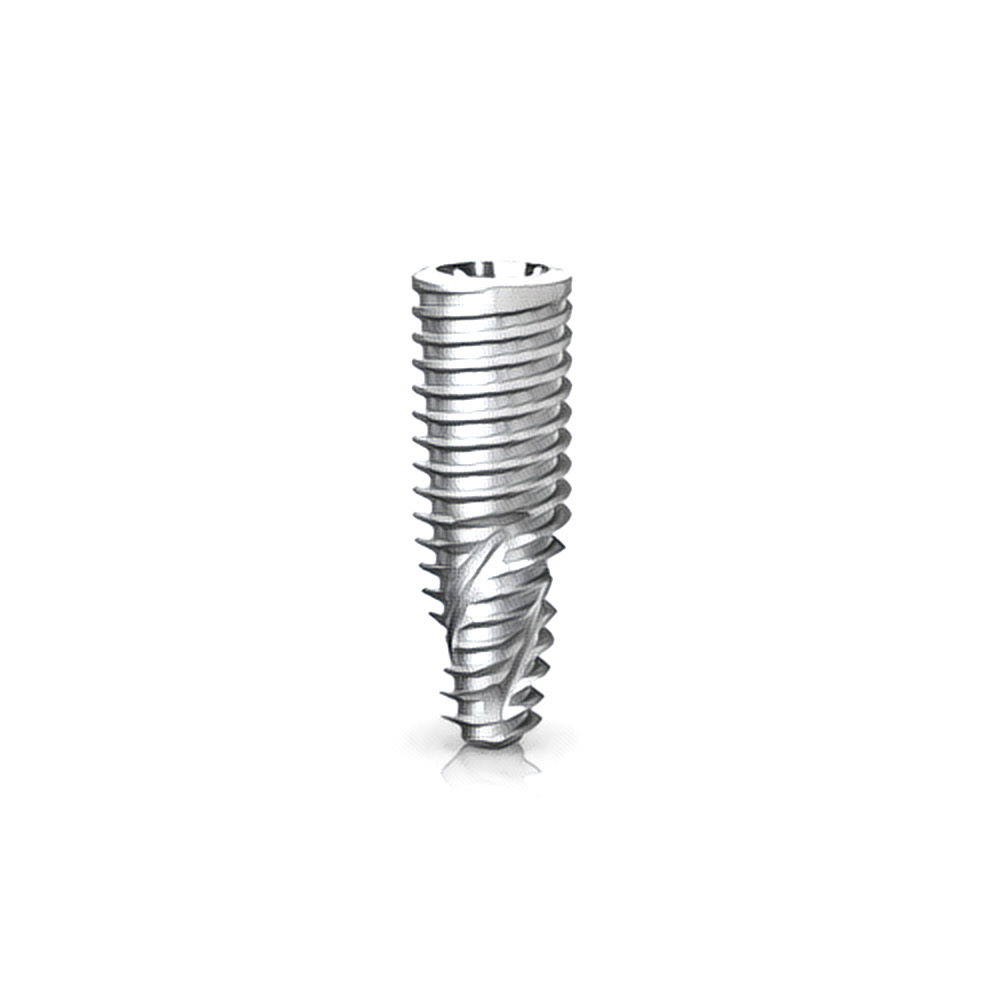
Six design elements that make the Helix Narrow the go-to solution for narrow ridge cases in anterior and premolar positions.
Slim enough to fit in ridges as narrow as 4–5 mm — maintaining the required 0.5 mm bone margin on each side — where standard 3.75 mm+ implants simply cannot be placed safely.
Designed for efficient engagement of the compact cortical-trabecular bone architecture typical of narrow anterior ridges. Balances primary stability with controlled insertion torque to prevent ridge fracture.
The full mechanical integrity of the Grand Morse Morse taper, adapted to the narrow platform. Cold-weld seal eliminates micromovement at the abutment interface — critical under lateral esthetic zone loads.
For ridges 4 mm or wider, the Helix Narrow frequently eliminates the need for lateral bone augmentation — saving months of treatment time and removing graft-related surgical risk from the treatment plan.
UV-activated hydrophilic SLA surface accelerates osseointegration — particularly valuable in narrow implants where BIC surface area is already reduced by the smaller diameter.
Medial shift of the biologic width supports stable papilla and soft tissue architecture around narrow-diameter placements in the esthetic zone — protecting the long-term result of anterior single-tooth cases.
Ideal cases for the Helix Narrow — and scenarios where augmentation or a different implant is the better choice.
Narrow implant technique modifications that protect the ridge, control torque, and ensure predictable osseointegration.
Use CBCT or direct ridge-mapping calipers to verify ≥ 4 mm ridge width for the 3.0 mm implant, or ≥ 4.5 mm for the 3.5 mm implant. Confirm bone height ≥ 8 mm and identify the proximity of adjacent root apices. Surgical guide or stent use is strongly recommended in anterior esthetic zone cases.
The Helix Narrow requires its own narrow bur sequence — do not use the standard Helix GM drill sequence. The narrow burs are specifically designed to create an osteotomy of the correct diameter and depth for the 3.0 or 3.5 mm implant body without risking cortical fracture or ridge splitting in narrow bone.
For CBCT-confirmed cases with adequate ridge width and favorable anatomy, a flapless approach is often feasible with a surgical stent. Flapless placement reduces mucosal trauma, preserves peri-implant soft tissue volume, and is associated with faster healing — particularly valuable in esthetic zone cases where papilla preservation is a priority.
Target insertion torque of 25–45 N.cm. Do not exceed 45 N.cm — narrow implants are susceptible to implant body fracture under excessive torsional stress, particularly if the osteotomy has been underprepared or the bone is unexpectedly dense. If resistance exceeds expectations, redrill one size up before forcing insertion.
Full diameter × length matrix for the Helix Narrow. Both Acqua and NeoPoros surfaces across all configurations.
| Diameter | 8 mm | 10 mm | 11.5 mm | 13 mm | Surface | Typical Site |
|---|---|---|---|---|---|---|
| 3.0 mm | ● | ● | ● | ● | Acqua / NeoPoros | Mandibular incisor, lateral maxilla |
| 3.5 mm | ● | ● | ● | ● | Acqua / NeoPoros | Lateral incisor, lower premolar, anterior |
Clinical answers to the questions clinicians most often ask when evaluating the Helix Narrow for their case.
Neodent implants and components that complement or pair with the Helix Narrow for complete case planning.
Request a quote for any diameter and length configuration. Our team responds within 24 hours with pricing, availability, and narrow platform component recommendations.