Neodent GM · Digital Prosthetic Component

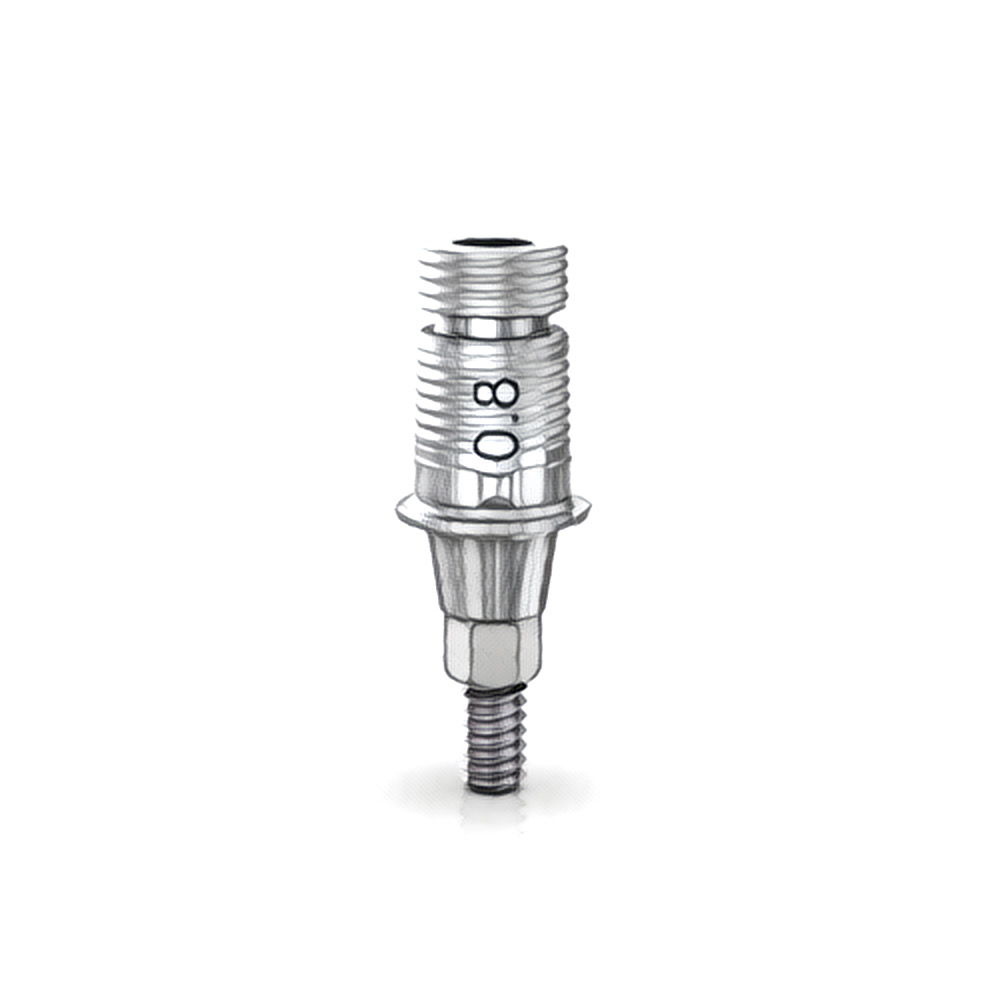
Neodent GM / Ti-Base

Titanium base for CAD/CAM hybrid abutment fabrication. Bond your lab's zirconia or PMMA crown directly to the Ti-Base for a perfect-fit, screw-retained restoration with no cement subgingival risk.

Ti-Base CAD/CAM Hybrid Abutment Grand Morse® Compatible Zirconia Crowns Screw-Retained
Pricing
Available on request · Contact for current pricing and available heights
Product
Ti-Base · Hybrid Abutment · Grand Morse® 16°

Product Overview

Component TypeTitanium Base (Ti-Base) — interface for CAD/CAM hybrid abutment-crown single-tooth restorations
Connection to ImplantGrand Morse® 16° internal cone — deep conical seating with anti-rotation engagement
Seating Torque20 N.cm — lower than implant-to-abutment torques due to smaller screw diameter
Top InterfaceFlat CAD/CAM bonding surface — scan-body compatible, open-format STL
Available Heights1 mm / 2 mm / 3 mm above tissue level
MaterialGrade IV commercially pure titanium body
CAD/CAM CompatibilityOpen STL format — compatible with all major CAD/CAM systems (Exocad, 3Shape, Cerec, etc.)
Crown MaterialsMonolithic zirconia (most common) · Lithium disilicate (e.max) · PMMA · Composite resin
Bonding ProtocolSandblast + silane + adhesive cement (zirconia); conventional cement (lithium disilicate)
Screw AccessScrew access channel through the crown — sealed with composite after seating
Primary IndicationSingle-tooth screw-retained restorations; digital CAD/CAM workflow; any position except full-arch bar cases

What is the GM Ti-Base?

The critical interface component that enables the modern digital prosthetic workflow for single-tooth implant restorations — replacing cemented crowns with screw-retained precision.

The Neodent GM Ti-Base is the critical interface component that enables the modern digital prosthetic workflow for single-tooth implant restorations. Rather than using a traditional prefabricated abutment on which a crown is cemented, the Ti-Base workflow uses CAD/CAM technology to design and mill a custom abutment-crown unit from zirconia, PMMA, or other materials, which is then bonded to the titanium base in the laboratory. The result is a screw-retained restoration with the mechanical reliability of a titanium-to-implant connection, the precision fit of a digitally milled crown, and the esthetic quality of a full-contour ceramic — without cement anywhere near the subgingival zone.

The Grand Morse Ti-Base engages the 16° internal cone at the implant level, maintaining all the anti-rotation stability and biological sealing properties of the GM connection. The torque for the Ti-Base is 20 N.cm — deliberately lower than the 32 N.cm used for MUAs and standard abutments, because the Ti-Base screw is smaller in diameter. Using incorrect (excessive) torque risks screw fracture. The top surface of the Ti-Base is a standardized flat interface — designed to be scanned directly in the laboratory model using a dedicated scan body — and the resulting STL data is used by the CAD/CAM software to design a crown that fits precisely over the Ti-Base geometry. The library files for the Neodent GM Ti-Base are available in all major CAD/CAM design software platforms, making it immediately compatible with any digital laboratory workflow.

The laboratory workflow proceeds as follows: after the digital intraoral scan (with scan body in place), the STL is sent to the laboratory. The technician designs the crown in CAD software — selecting the Ti-Base library, designing the full-contour crown in the desired material, and planning the screw access channel. The crown is milled (zirconia block, PMMA disc, or lithium disilicate block), sintered if zirconia, surface-treated (sandblasting + silane for zirconia), and bonded to the Ti-Base analog using adhesive cement. The bonded assembly is verified on the stone or digital model before delivery. At the chairside appointment, the clinician seats the Ti-Base with the pre-bonded crown as a single unit, inserts the screw, torques to 20 N.cm, and seals the screw access with composite. The patient leaves with a final restoration delivered in a single appointment after the lab work is complete.

The decisive clinical advantage of the Ti-Base workflow over conventional cemented crowns is retrievability and the elimination of cement. Subgingival cement excess is one of the most common causes of peri-implantitis — a biofilm-retentive foreign body that triggers chronic peri-implant inflammation and bone loss. Screw-retained restorations using the Ti-Base eliminate this risk entirely: there is no cement in the subgingival environment. Additionally, if a complication arises (crown fracture, screw loosening, or need for re-treatment), the restoration can be removed by unscrewing — non-destructively — for repair or replacement. A cemented crown, by contrast, must typically be destroyed to remove it.
Why the Ti-Base Workflow Wins

Six clinical and technical advantages that make the Ti-Base the preferred prosthetic interface for single-tooth digital implant restorations.

🔩
Screw-Retained — Zero Cement Risk
No cement is placed subgingivally at any stage. The crown is bonded to the Ti-Base in the laboratory, above the gum line, in a controlled and cleanable environment. Subgingival cement excess — a primary driver of peri-implantitis — is completely eliminated from the procedure.
🔄
Retrievable — Clinician-Removable
Any complication can be addressed without destroying the restoration. Remove the screw access composite seal, unscrew the Ti-Base, remove the crown-abutment unit, address the issue, and re-seat. This non-destructive retrievability is the standard of care in modern implant prosthetics.
💻
Open-Format CAD/CAM Compatibility
Ti-Base library files are available for all major CAD/CAM design platforms: Exocad, 3Shape Dental Designer, DentalCAD, Cerec SW, and others. Any laboratory with a digital workflow can design and mill a crown for the Neodent GM Ti-Base without proprietary system restrictions.
🔗
Grand Morse® 16° Cone Precision
The same deep-cone GM connection as all GM implant prosthetics. Provides the biological seal and mechanical stability of the cone morse interface at the implant level — while the bonded crown above provides esthetic quality. Best-of-both-worlds: titanium connection, ceramic esthetics.
🎨
Multiple Crown Material Options
Monolithic zirconia for maximum strength in posterior positions; lithium disilicate (e.max) for maximum esthetic translucency in the anterior zone; PMMA for provisionals; composite resin for budget restorations. The Ti-Base workflow accommodates the full range of CAD/CAM crown materials.
Simplified Chairside Seating
Because all fitting, bonding, and verification is done by the laboratory on an analog model, the chairside seating appointment is simple: insert the pre-assembled Ti-Base + crown unit, torque the screw to 20 N.cm, verify occlusion, and seal the access hole. No complex cementation procedure at the chair.

When to Use the Ti-Base

The Ti-Base is the default prosthetic interface for all single-tooth digital implant workflows on Grand Morse implants.

Single-Tooth Posterior Restorations

Molars and premolars with adequate occlusal clearance for a screw access channel. Monolithic zirconia bonded to Ti-Base is the most durable and functional option for high-load posterior positions. Eliminates cement failure risk under masticatory load that affects conventionally cemented posterior crowns on implants.

Esthetic Zone Single Teeth

Maxillary incisors, canines, and premolars. Lithium disilicate crowns bonded to Ti-Base provide superior translucency and esthetic quality for the critical anterior zone, while maintaining the screw-retained retrievability advantage. The Ti-Base gingival height is selected to produce a natural emergence profile.

Full Digital Workflow Cases

Practices running fully digital workflows (intraoral scan → digital design → milling → bonding) will find the Ti-Base as the cornerstone component of single-tooth digital prosthetics. From scan to delivery, the workflow eliminates physical impressions, stone models, and the variables associated with conventional impression-based prosthodontics.

PMMA Provisionals

PMMA (polymethylmethacrylate) bonded to a Ti-Base creates an esthetic, durable, and retrievable provisional restoration that can be worn for 3–6 months during osseointegration or soft tissue maturation. When the definitive restoration is ready, the PMMA provisional is removed and replaced with the final zirconia or e.max crown on a new Ti-Base.

Immediate Temporization

In immediate implant placement protocols, a Ti-Base with a PMMA or milled composite provisional can be seated on the day of surgery to provide esthetics during healing. The provisional is fabricated pre-surgically based on CBCT planning and a pre-operative intraoral scan, and seated immediately after implant placement when primary stability criteria are met.

Replacement of Failed Cemented Crowns

When a previously cemented implant crown has failed — due to cement dissolution, subgingival cement complications, crown fracture, or abutment failure — the Ti-Base workflow provides a superior replacement that eliminates all the failure modes of the original cemented approach, converting the case to a retrievable screw-retained restoration.

Ti-Base Protocol — Step by Step

From implant placement to final seating — the complete Ti-Base digital workflow from surgery to delivery.

1

Implant Placement and Healing

Place the GM implant per standard protocol. Seat a healing abutment or scan body cover. Allow osseointegration (standard 8–12 weeks for conventional loading; follow immediate loading protocol if primary stability criteria are met).

2

Digital Intraoral Scan with Scan Body

Remove healing abutment, seat the Neodent GM scan body, and take a full-arch intraoral scan. Capture gingival margin, adjacent teeth, and occlusion. Export as STL. Remove scan body and replace healing abutment between impressions if needed.

3

STL Transmission to Laboratory

Send the STL files to the digital laboratory. The lab imports the data into CAD software (Exocad, 3Shape, etc.), loads the Neodent GM Ti-Base library, and designs the full-contour crown adapted to the Ti-Base bonding surface, respecting the screw access channel position.

4

Crown Milling and Surface Treatment

The lab mills the crown from the appropriate block (zirconia, e.max, PMMA). Zirconia crowns are sintered to final density, then surface-treated: airborne particle abrasion + silane coupling agent. Lithium disilicate crowns receive HF etching + silane treatment for adhesive bonding.

5

Laboratory Bonding of Crown to Ti-Base

The lab applies the bonding protocol to the Ti-Base bonding surface (sandblast + adhesive primer + adhesive resin) and seats the milled crown onto the Ti-Base analog in the correct position. The assembly is light-cured and excess adhesive removed under magnification. Fit and emergence profile are verified on the model.

6

Chairside Seating — 20 N.cm Torque

Remove the healing abutment. Clean and dry the implant connection. Insert the pre-assembled Ti-Base + crown unit. Seat the Ti-Base screw with a calibrated torque wrench to exactly 20 N.cm. Verify occlusion with articulation paper. Seal the screw access channel with a PTFE tape base and composite, then light-cure and adjust occlusal contacts on the composite seal.

Available Heights and Compatible Crown Materials

Three heights above tissue to match tissue depth at each implant site. All heights use the same Grand Morse® 16° connection and 20 N.cm torque.

1 mm above tissue
2 mm above tissue
3 mm above tissue
Height Clinical Use Connection Torque
1 mmShallow tissue at implant site; implant platform near gingival crestGrand Morse® 16°20 N.cm
2 mmStandard tissue depth — most frequently used height for regular implant depthGrand Morse® 16°20 N.cm
3 mmDeep tissue or subcrestal implant placement; longer collar for thick biotype sitesGrand Morse® 16°20 N.cm
Monolithic Zirconia
Lithium Disilicate (e.max)
PMMA Provisional
Composite Resin
Layered Zirconia
MaterialIndicationBonding ProtocolKey Advantage
Monolithic ZirconiaPosterior single teeth — all positionsAirborne particle abrasion + silane + adhesive resin cementMaximum strength; ideal for high-load molar/premolar positions; cleanable surface
Lithium DisilicateAnterior esthetic zone — incisors, caninesHF acid etch + silane + adhesive resin cementSuperior translucency and esthetic depth; optimal for anterior cases demanding premium esthetics
PMMA ProvisionalTemporary restoration during healing phaseAcrylic-based adhesive; PMMA-primer + bonding resinEasy to mill; adjustable chairside; esthetic during 3–6 month provisional period
Composite ResinBudget-conscious cases; lab or chairside fabricationSilane + bonding agent + light-cure compositeLow cost; directly fabricated chairside or in lab with composite pressing system
Height selection guide: The Ti-Base collar top should be at or 0.5 mm above the gingival margin. Measure tissue depth at the implant site with a probe. If the implant platform is at bone level with 2 mm of tissue above it, a 1–2 mm Ti-Base is typically correct. Subgingival Ti-Base collars complicate cleaning and can cause soft tissue inflammation. Supragingival placement too far above tissue looks unnatural — the crown emergence should appear to arise from the gingival margin cleanly.

Frequently Asked Questions

What is the difference between a Ti-Base and a regular prefabricated abutment?
A conventional prefabricated abutment is a fixed titanium or zirconia component onto which a crown is cemented externally — either at the chair or in the lab. Cement is applied in the subgingival zone, creating a risk of excess cement extrusion below the gingival margin. A Ti-Base, by contrast, is bonded to the CAD/CAM crown inside the laboratory, above the gingival zone, in a controlled environment. The result is a screw-retained unit with no cement in the subgingival space, no cement failure risk, and full retrievability at any future appointment.
Why is screw-retained better than cemented?
Two primary reasons: retrievability and the elimination of cement risk. Retrievability means that if anything goes wrong — crown fracture, screw loosening, need for gingival re-treatment, implant issues — the crown can be removed non-destructively by any dentist with the correct driver. Cemented crowns must typically be cut off, risking implant surface damage. Cement risk elimination means no possibility of subgingival cement excess causing peri-implantitis — a condition that can lead to progressive bone loss and implant failure that is directly attributable to cement debris that could not be cleaned from the sulcus after crown delivery.
What crown materials work best with the Ti-Base?
For posterior positions (premolars, molars), monolithic zirconia is the first choice: maximum flexural strength, resistance to fracture under occlusal load, and excellent cleanability of the smooth milled surface. For the anterior zone (incisors, canines) where esthetics are critical, lithium disilicate (e.max) provides superior translucency and optical depth. PMMA is used for provisional restorations. The choice depends on the specific case — load, esthetic requirements, tissue thickness, and patient preferences — and should be discussed between the clinician and laboratory technician at the planning stage.
Do I need a specific intraoral scanner to use the Ti-Base workflow?
No — any intraoral scanner that accepts open STL format works with the Neodent GM Ti-Base workflow. Use the corresponding Neodent GM scan body at the implant position (the scan body is a separate, reusable component that indexes into the implant connection and provides the geometry the scanner maps). The STL files exported from any compatible scanner are sent to the laboratory, where the Ti-Base library files are used to design the crown. The workflow is completely scanner-brand-agnostic.
What torque do I use for the Ti-Base screw?
20 N.cm — always with a calibrated torque wrench. This is significantly lower than the 32 N.cm used for MUAs and the 35+ N.cm used for implant placement, because the Ti-Base prosthetic screw has a smaller diameter. Applying 32 N.cm to a Ti-Base screw risks fracturing it. Verify your torque wrench setting before each seating appointment, use the specific Neodent GM Ti-Base driver geometry, and never apply torque without a confirmed calibrated instrument. After seating, place a PTFE tape liner at the bottom of the screw access channel before filling with light-cured composite — this allows future retrieval without drilling into the screw head.

Complete the Single-Tooth Digital Workflow

The Ti-Base pairs with the full Neodent GM implant line. These are the implants most commonly restored with the GM Ti-Base.

Request Ti-Base Pricing

Contact our team for current stock, pricing, and clinical guidance on the digital Ti-Base workflow for Neodent GM implants.