Short implant solution for reduced bone height. Same Grand Morse® reliability in 5.5 and 6 mm lengths — avoiding sinus lifts and mandibular nerve proximity risks.
Short dual-tapered geometry with progressive compressive threads and Grand Morse® 16° connection — engineered for anatomically restricted posterior sites.
| Implant Type | Short tapered (dual taper) — progressive compressive thread design |
| Thread Design | Progressive V-shape + compressive thread pattern |
| Connection | Grand Morse® 16° internal Morse taper |
| Platform | Platform switching — crestal bone preservation |
| Surface Options | Acqua (hydrophilic SLA) / NeoPoros (SLA acid-etched) |
| Available Diameters | 4.3 mm / 5.0 mm / 6.0 mm |
| Available Lengths | 5.5 mm / 6.0 mm |
| Primary Indication | Reduced bone height — posterior maxilla & mandible |
| Max Insertion Torque | 60 N.cm |
| Loading Protocol Torque | ≥ 35 N.cm for immediate / early loading |
| Material | Grade IV commercially pure titanium / Ti-6Al-4V ELI |
| Regulatory | ANVISA registered · CE marked · FDA cleared |
A paradigm shift in posterior rehabilitation for reduced bone height — without bone grafting morbidity.
Short implants fundamentally changed the approach to posterior rehabilitation. For decades, vertical bone deficiency in the posterior maxilla or mandible forced clinicians into two options: bone grafting — with its associated cost, extended healing time, donor-site morbidity, and additional surgical appointments — or simply not placing implants. The Neodent Helix Short reframes this challenge entirely. Instead of building bone upward to accommodate a standard-length implant, the clinician works with what already exists. The 5.5 mm and 6.0 mm lengths are precisely engineered to engage the maximum available bone safely, respecting the sinus floor, the inferior alveolar nerve canal, or any adjacent anatomical structure without compromise.
The wide diameter options — 4.3, 5.0, and 6.0 mm — are not incidental. They are a deliberate engineering response to the reduced axial length: greater diameter translates directly into greater bone-to-implant contact surface area. Evidence from long-term multicenter studies and systematic reviews confirms that short implants achieve survival rates of 94–97% over 5 years in posterior locations when correct diameter selection is applied and the osteotomy underpreparation protocol is followed. The surface technology — Acqua hydrophilic SLA or NeoPoros conventional SLA — ensures rapid osseointegration even in the cancellous-dominant bone typical of posterior sites.
The Grand Morse® 16° internal Morse taper connection is the same mechanically superior interface shared across the entire Neodent Helix platform. This conical connection generates a cold-weld-like seal that eliminates micromovement at the implant-abutment junction and reduces bacterial microleakage — critical factors when the implant is working in a mechanically demanding posterior environment with reduced axial support. The platform switching design at the crestal level further protects marginal bone, allowing stable peri-implant tissue architecture over the long term.
The key technical modification when placing Helix Short implants is underpreparing the osteotomy by one drill size relative to standard protocol. Posterior bone — particularly in the maxilla — is typically softer (D3–D4 density), and underpreparation is essential to achieve the primary stability required for predictable osseointegration and early loading. Combined with the wide-diameter approach, this single technique adjustment transforms a site that would otherwise require a sinus lift or bone graft into a site that can receive an implant on the same day as planning — delivering a faster, safer, and more cost-effective outcome for the patient.
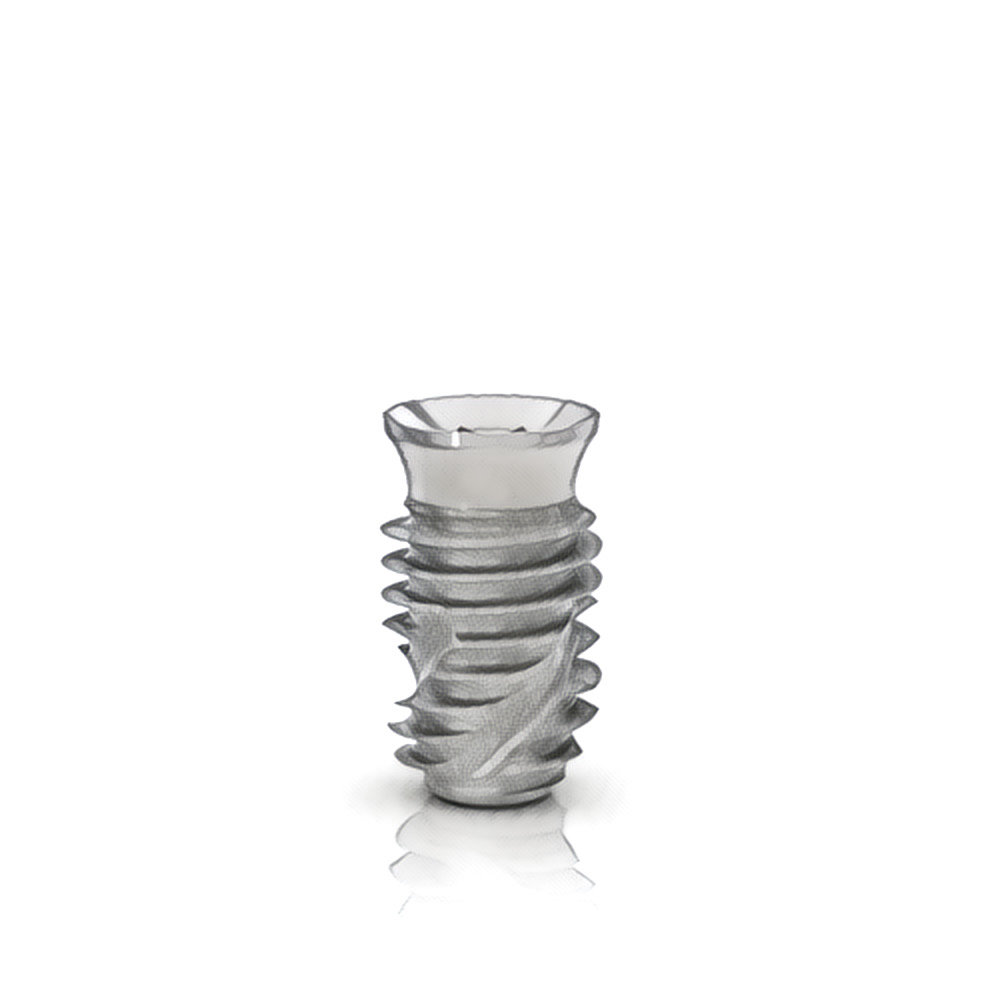
Six design elements that define the Helix Short's clinical performance in anatomically restricted posterior sites.
Cylindrical coronal section transitions into a tapered apical body, delivering progressive bone compression and outstanding primary stability in soft posterior bone — without full cortical engagement.
The V-shape compressive thread applies lateral forces to surrounding bone during insertion, maximizing mechanical engagement per millimeter of length. Critical in D3–D4 bone density.
Diameters of 4.3–6.0 mm increase bone-to-implant contact area laterally, ensuring biomechanical competence despite the reduced 5.5–6.0 mm axial length. Width compensates for lost depth.
Internal Morse taper creates a friction-locked cold-weld seal at the implant-abutment interface, eliminating micro-gap and bacterial infiltration at the bone crest under posterior occlusal loads.
UV-activated hydrophilic SLA surface accelerates protein adsorption and cell adhesion at first contact. Reduces osseointegration time by up to 40% vs. conventional SLA — critical in short implants.
The reduced prosthetic platform diameter shifts the biologic width medially, protecting crestal bone and supporting healthy peri-implant tissue — protecting the short implant's critical marginal bone.
When to choose the Helix Short — and when a different approach is indicated.
Key technique modifications that define success with short implants — where standard protocol alone is insufficient.
Obtain CBCT imaging before case acceptance. Measure exact available bone height from the crest to the anatomical limit. Confirm minimum 6 mm of bone and adequate width for the selected diameter. Identify bone density (D1–D4) to calibrate the underpreparation strategy for that specific site.
Default to the widest diameter the available ridge width accommodates safely. If a standard-length case would use 3.75 mm, consider 4.3 mm or 5.0 mm for the Helix Short placement. Wider diameter = more bone-to-implant contact = better primary stability = more predictable clinical outcome.
Use the Neodent short implant drill sequence and stop one drill size below the implant diameter. This is the most critical modification. In D3–D4 bone, underpreparing creates the lateral compressive engagement that allows the progressive thread to achieve primary stability necessary for osseointegration and loading.
For immediate or early loading (4–6 weeks), confirm insertion torque ≥ 35 N.cm. If torque falls below 25 N.cm, use a fully submerged healing protocol of 8–12 weeks before prosthetic loading. Do not compromise loading protocol — premature loading of a poorly stabilized short implant is the primary cause of failure.
When replacing a first or second molar, place two Helix Short implants and splint them with a two-unit bridge rather than loading a single short implant under full molar occlusal force. Two splinted short implants distribute force laterally and perform equivalently to single standard-length implants in the literature — this is a validated, well-documented protocol.
All diameter × length combinations for the Helix Short. Both Acqua and NeoPoros surfaces available across the full matrix.
| Diameter | 5.5 mm | 6.0 mm | Surface Options | Typical Site |
|---|---|---|---|---|
| 4.3 mm | ● | ● | Acqua / NeoPoros | Narrower posterior ridge, moderate space |
| 5.0 mm | ● | ● | Acqua / NeoPoros | Standard posterior maxilla and mandible |
| 6.0 mm | ● | ● | Acqua / NeoPoros | Wide crest — broad molar / second molar |
Clinical answers to the most common questions about short implant selection and technique.
Other Neodent implants and components that complement or pair with the Helix Short.
Request a quote for any diameter and length configuration. Our team responds within 24 hours with pricing, availability, and compatible prosthetic component recommendations.