Engineered for maximum primary stability in compromised bone. Square-thread body with reverse cutting chambers compresses and engages bone simultaneously — delivering immediate-loading confidence where V-thread implants fall short.
Complete technical data for the Neodent Drive GM tapered implant system. All specifications are current as of the latest Neodent product documentation.
| Parameter | Specification |
|---|---|
| Implant Type | Full Tapered (conical body) |
| Thread Design | Square-shape profile · Double threaded (dual lead) |
| Cutting Chambers | Reverse cutting chambers distributed across the full implant body (not apex-only) |
| Apex Design | Rounded apex with sharp self-cutting edge |
| Connection Type | Grand Morse® 16° internal cone (Morse taper) |
| Platform Design | Platform switching — prosthetic platform narrower than implant platform |
| Surface Treatment | Acqua (hydrophilic) — recommended for immediate loading · NeoPoros (SLA equivalent) — cost-effective option |
| Available Diameters | 3.75 mm · 4.3 mm · 5.0 mm |
| Available Lengths | 7 · 8 · 9 · 11 · 13 · 15 · 17 mm |
| Primary Indication | Bone Types III and IV (soft/porous bone) — posterior maxilla, atrophic ridges |
| Secondary Indication | Works effectively in Bone Types I and II with appropriate protocol adjustment |
| Maximum Insertion Torque | 60 N.cm rated — 35+ N.cm recommended for immediate loading |
| Material | Grade IV commercially pure titanium (cpTi) — TiO₂ surface oxide layer |
| Compatibility | All Neodent Grand Morse prosthetic components, MUAs, Ti-Bases, impression copings |
| Sterilization | Pre-sterilized, gamma-irradiated, single use |
| Regulatory | ANVISA registered · CE marked · FDA 510(k) cleared |
The Neodent Drive GM was developed specifically to address the most clinically challenging implant scenarios — soft, porous bone classified as Types III and IV — where achieving reliable primary stability with conventional implant designs is notoriously difficult. Bone Type IV, most commonly found in the posterior maxilla and in older patients with reduced bone density, presents with a thin cortical shell and a coarse, low-density trabecular core. In these conditions, standard V-thread implants often compress poorly, spin, or fail to generate the insertion torque required for immediate or early loading protocols.
The Drive GM's defining engineering innovation is its square-thread geometry. Unlike V-shaped threads, which are designed to cut through bone as the implant advances, square threads interact with bone through lateral compression. As the Drive GM rotates into the osteotomy, its flat thread faces push outward against the bone walls, consolidating and densifying the trabecular structure around the entire implant body. This bone compression effect directly increases bone-to-implant contact (BIC) and insertion torque, often delivering ISQ values 10 to 15 points higher than V-thread alternatives in equivalent Type III/IV bone sites.
Complementing the square threads is a network of reverse cutting chambers distributed throughout the full implant body — not merely at the apex as seen in many competing designs. These chambers serve a dual function: they evacuate excess bone debris during insertion, preventing dangerous hydraulic pressure buildup within the osteotomy, and they provide discrete zones where bone grows into the implant body during osseointegration. This combination of features makes the Drive GM uniquely effective for immediate loading protocols in compromised bone, a scenario where predictability is paramount.
At its coronal connection, the Drive GM employs the Grand Morse 16° internal cone — Neodent's hallmark connection architecture. The deep Morse taper creates a cold-weld friction seal between implant and abutment, virtually eliminating micromovement at the implant-abutment interface. Combined with platform switching geometry, this connection design promotes crestal bone maintenance over the long term, preserving the biologic width and protecting the peri-implant tissue architecture even in cases with limited initial bone volume.
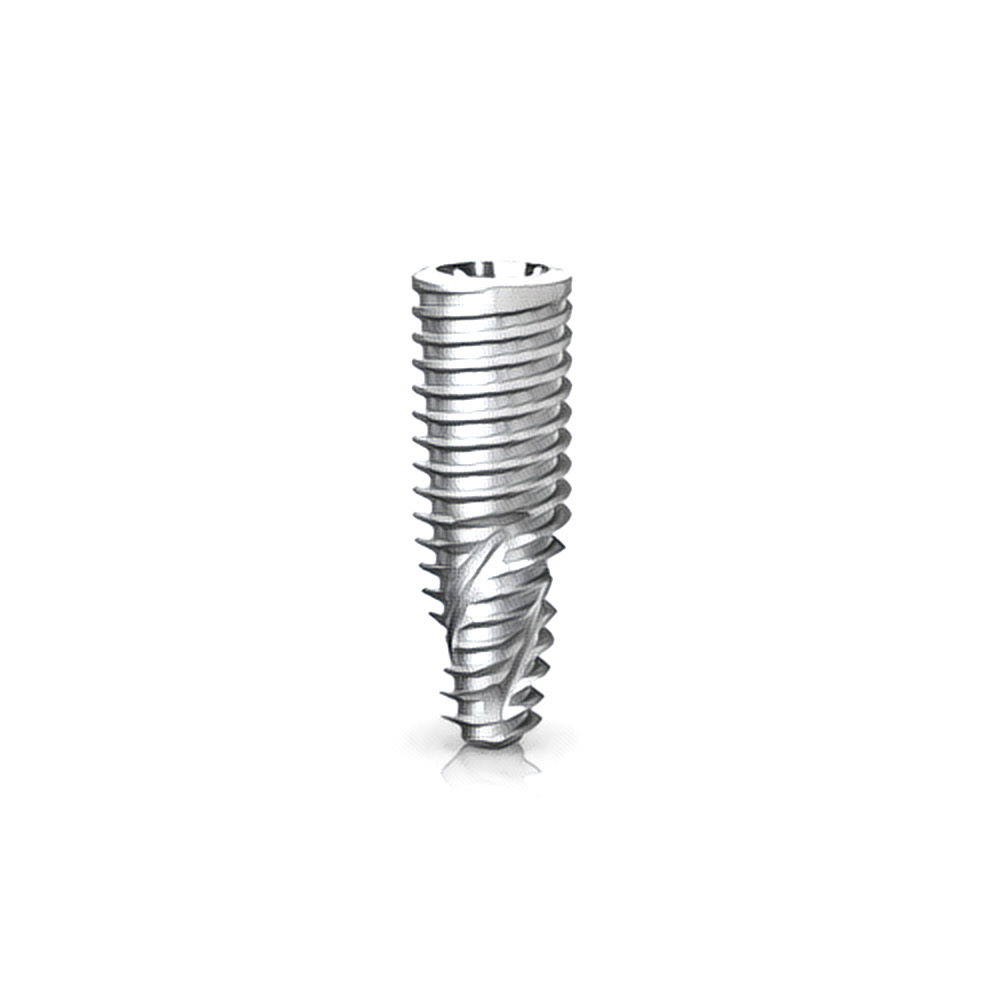
Six clinically meaningful design features that translate directly into better outcomes in compromised bone scenarios.
The Drive GM excels in specific clinical scenarios. Understanding when to choose it — and when to choose a different design — is critical for predictable outcomes.
Key protocol considerations for Drive GM placement. Always refer to the official Neodent surgical manual for complete step-by-step guidance.
Experienced Drive GM users describe a distinctive resistance build-up during insertion compared to V-thread implants. In Type III/IV bone, you should feel progressive resistance increasing from mid-body to final seating — this resistance IS the bone being compressed and indicates the square threads are working as designed. If insertion is completely free with no resistance increase, the osteotomy may be oversized or the bone may be D4-extreme — reconsider your loading protocol and consider grafting at time of placement.
All available diameter × length combinations for the Neodent Drive GM. Check marks indicate available configurations for both Acqua and NeoPoros surfaces.
| Diameter ↓ / Length → | 7 mm | 8 mm | 9 mm | 11 mm | 13 mm | 15 mm | 17 mm |
|---|---|---|---|---|---|---|---|
| 3.75 mm | ✓ | ✓ | ✓ | ✓ | ✓ | ✓ | ✓ |
| 4.3 mm | ✓ | ✓ | ✓ | ✓ | ✓ | ✓ | ✓ |
| 5.0 mm | ✓ | ✓ | ✓ | ✓ | ✓ | ✓ | ✓ |
All configurations available in both Acqua (hydrophilic) and NeoPoros (SLA) surface treatments. Contact us for pricing on specific configurations.
Answers to the questions clinicians ask most often about the Drive GM before and after their first cases.
Get a personalized quote with current pricing, availability, and volume discounts. Our team responds within 2 hours during business hours.
Request Drive GM Quote on WhatsApp