The prosthetic interface for full-arch fixed rehabilitations on Grand Morse implants. Available in 0°, 17°, and 30° angles to correct implant angulation and create a unified prosthetic platform above the gingival level.
| Component Type | Multi-Unit Abutment — prosthetic interface for full-arch screw-retained fixed rehabilitations |
| Connection to Implant | Grand Morse® 16° internal cone — full hex anti-rotation engagement at implant level |
| Seating Torque | 32 N.cm — calibrated torque wrench required; do not estimate by feel |
| Prosthetic Connection (top) | Standard MUA tube — accepts screw-retained bar frameworks, prosthetic cylinders, CAD/CAM components |
| Available Angulations | 0° (straight) / 17° (standard angled) / 30° (high angle) |
| Gingival Heights | 1 mm / 2 mm / 3 mm / 4 mm — selected based on tissue thickness at each implant site |
| Material | Grade V titanium alloy (Ti-6Al-4V) — maximum fatigue resistance for full-arch occlusal load |
| Screw | Included — dedicated GM MUA prosthetic screw, titanium alloy |
| Compatibility | Neodent GM implants exclusively — not interchangeable with other connection systems |
| Loading Protocol | Immediate loading supported — seat MUA on day of surgery and deliver provisional same day |
| Primary Indication | All-on-4, All-on-6, full-arch hybrid prostheses, pterygoid and zygomatic implant cases |
The foundational prosthetic component that makes full-arch fixed rehabilitation on tilted implants a clinical reality.
Multi-Unit Abutments are the engineering solution that transformed full-arch implant prosthetics into a standardized, reproducible protocol. In an All-on-4 or All-on-6 rehabilitation, the underlying implants are placed at varying angles dictated by available bone — the two anterior implants may be straight, while the posterior implants are deliberately tilted at 30–45° to avoid the maxillary sinus or mandibular nerve and maximize prosthesis support length. Without MUAs, connecting a single rigid prosthesis to four implants at radically different angles would create severe stress concentration at the connections. The MUA solves this by creating a gingival-level platform above each implant where the prosthesis connects — allowing the MUA angle to compensate for the implant angle and producing parallel connection points at a uniform height, regardless of what the implants are doing below the gumline.
The Neodent GM Multi-Unit Abutment engages the Grand Morse® 16° internal cone at the implant level. This deep conical seating generates compression between the implant and abutment — the same mechanism that gives the GM system its anti-rotation stability and biological seal. At 32 N.cm, the MUA is locked to the implant with negligible micromovement and a tight seal at the interface. Above the shoulder, the MUA presents a standard prosthetic tube compatible with Neodent GM bar components, screw-retained cylinders, CAD/CAM milled frameworks, and prefabricated prosthetic components — the complete ecosystem of full-arch solutions. The MUA is seated once at surgery and is typically left permanently in place as the stable long-term anchor for the overlying prosthesis.
The three available angulations (0°, 17°, and 30°) address the three primary clinical scenarios in full-arch rehabilitation. The 0° straight MUA is used on axially placed anterior implants where no correction is required. The 17° angled MUA is the workhorse of All-on-4 — used on moderately tilted posterior implants. The 30° angled MUA addresses the most angulated positions: maximally tilted posterior implants, pterygoid implants, and zygomatic implants, where the body angle relative to the prosthetic plane exceeds 25°. Together, these three angulations allow the surgeon and prosthodontist to achieve prosthetic parallelism in virtually any full-arch implant configuration without custom or patient-specific components.
The four gingival heights (1, 2, 3, and 4 mm) serve an equally critical function: they allow the MUA shoulder to be positioned at the ideal level relative to soft tissue. Implants at different sites will have varying distances from their platform to the gingival surface. Selecting the correct gingival height ensures the prosthetic connection emerges cleanly at or just above the gingival margin at every position — creating a hygienic, accessible interface that patients can maintain long-term. An incorrectly selected gingival height (too deep) creates a subgingival connection zone that accumulates plaque and drives peri-implant mucositis.
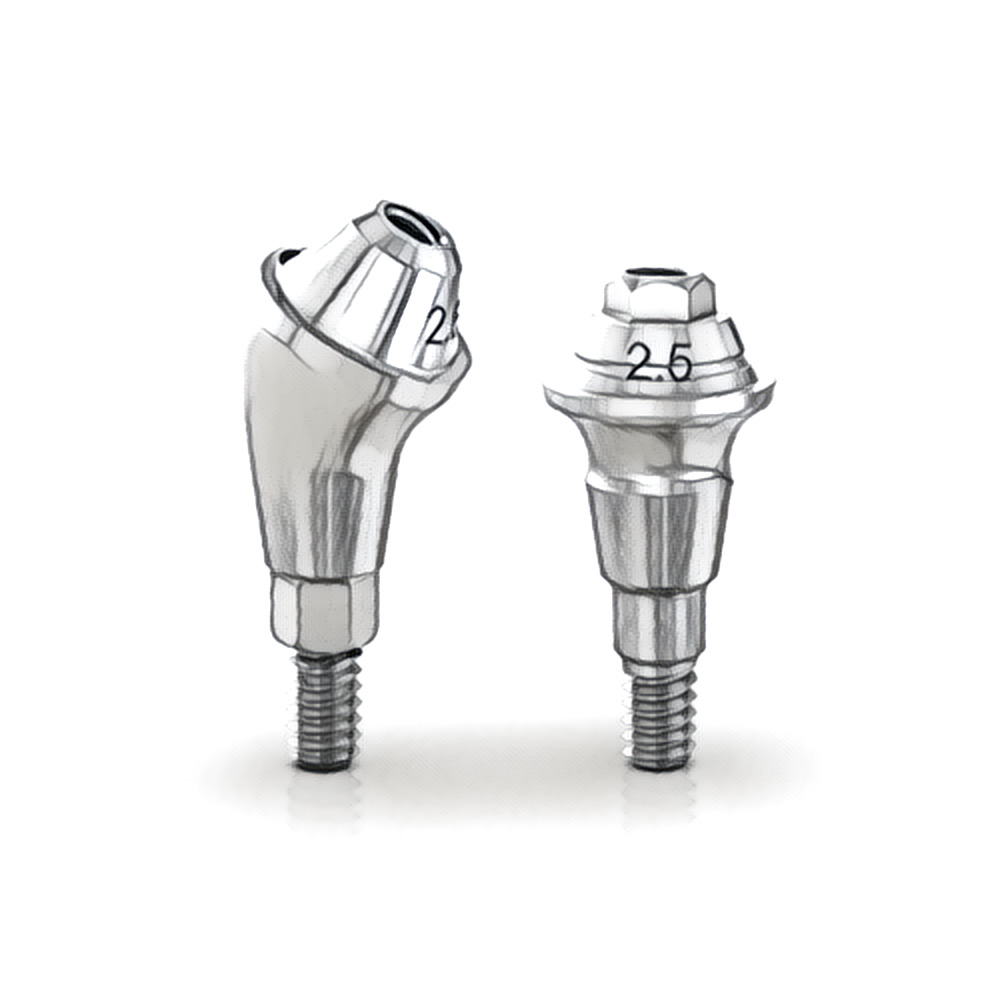
Correct angulation selection is the defining prosthetic decision in full-arch implant planning.
MUAs are the core prosthetic component across every full-arch fixed rehabilitation protocol on Grand Morse implants.
Classic configuration: 2 straight anterior implants with 0° MUAs + 2 tilted posterior implants with 17° or 30° MUAs. Provides complete arch support on four implants with immediate loading capability. The four MUAs create the parallel platform for the fixed screw-retained provisional and final prosthesis.
Extended configuration with 6 implants for greater load distribution: 4 implants anteriorly with 0° MUAs + 2 angled posterior implants with 17° MUAs. Reduces cantilever length and allows a longer arch. Preferred for larger maxillary arches and patients with higher bite forces.
Zygoma GM and Zygoma S implants emerge at significant angles. MUAs — typically 30° — are mandatory to convert the zygomatic emergence into a prosthetically usable direction. All zygomatic full-arch configurations use MUAs as the prosthetic interface layer between implant and prosthesis.
Pterygoid implants are placed at 40–45° trajectories. The 30° MUA is essential to correct this extreme angle for prosthetic connection. Pterygoid implants combined with anterior conventional implants in an All-on-4-type layout are an alternative to zygomatic solutions in select patients with available pterygoid bone.
Milled titanium or cobalt-chrome bar frameworks sit on MUA tubes as the rigid foundation for full-arch acrylic prostheses with denture teeth. The MUAs provide standardized connection points the bar is designed around, with prosthetic screws at each MUA position creating a retrievable, repairable prosthesis.
Monolithic zirconia full-arch bridges — milled from CAD/CAM — connect to MUAs via titanium inserts bonded into the zirconia at each screw access channel. This composite structure (titanium MUA + bonded insert + monolithic zirconia) delivers maximum strength, esthetics, and long-term cleanability.
From surgical planning to definitive prosthesis — the MUA's role at every stage of the full-arch protocol.
Use CBCT-guided planning software (coDiagnostiX or equivalent) to plan implant positions and trajectories before surgery. For each planned implant, pre-select the MUA angle that produces a prosthetically parallel emergence. Pre-select gingival heights based on planned tissue thickness at each site. Ordering MUAs pre-operatively eliminates intra-operative decision delays.
Immediately after each implant is placed and primary stability confirmed, seat the pre-selected MUA. Engage the Grand Morse cone by hand first to verify correct anti-rotation seating. Torque to 32 N.cm with a calibrated wrench. Confirm MUA orientation — the prosthetic tube must point in the correct direction relative to the planned prosthetic axis. MUAs can be repositioned before final torque if the orientation is incorrect.
Attach MUA impression copings (open tray) or MUA scan bodies (digital) to each abutment. Take a full-arch impression or digital scan capturing all MUA positions simultaneously. The lab mounts on MUA analog models and designs the prosthesis framework around the captured positions. Digital workflows using a properly calibrated intraoral scanner and Neodent GM scan bodies produce accurate, high-resolution virtual models.
For immediate loading cases, the provisional full-arch prosthesis is seated on the day of surgery. The provisional connects to MUAs via temporary prosthetic cylinders and screw-retained connections. Adjust occlusion carefully — eliminate prematurities and lateral excursive contacts. The provisional carries functional load during osseointegration and must be in light, balanced, non-lateral contact only.
At 3–6 months post-surgery (after confirmed osseointegration), take the definitive impression or scan for the final prosthesis. The definitive framework — whether milled titanium bar + acrylic, CAD/CAM full-arch zirconia, or PEEK hybrid — is seated on the same MUAs that were placed at surgery. MUAs remain permanently in situ and serve as the stable, long-term implant-to-prosthesis interface throughout the patient's life.
Twelve configurations across three angles and four gingival heights. Select based on implant tilt and tissue thickness at each site.
| Angulation | Gingival Heights | Clinical Application | Seating Torque |
|---|---|---|---|
| 0° Straight | 1 / 2 / 3 / 4 mm | Axially placed anterior implants; no angulation correction required | 32 N.cm |
| 17° Angled | 1 / 2 / 3 / 4 mm | Moderately tilted posterior implants (15–25°); standard All-on-4 posterior position | 32 N.cm |
| 30° High-Angle | 1 / 2 / 3 / 4 mm | Highly tilted implants (>25°); pterygoid and zygomatic implants (Zygoma GM / Zygoma S) | 32 N.cm |
MUAs work with the complete Neodent GM implant ecosystem. These are the implants most commonly paired with GM MUAs in full-arch cases.
Contact our team for current stock, pricing, and full-arch clinical support. We carry all angles and gingival heights with fast shipping.