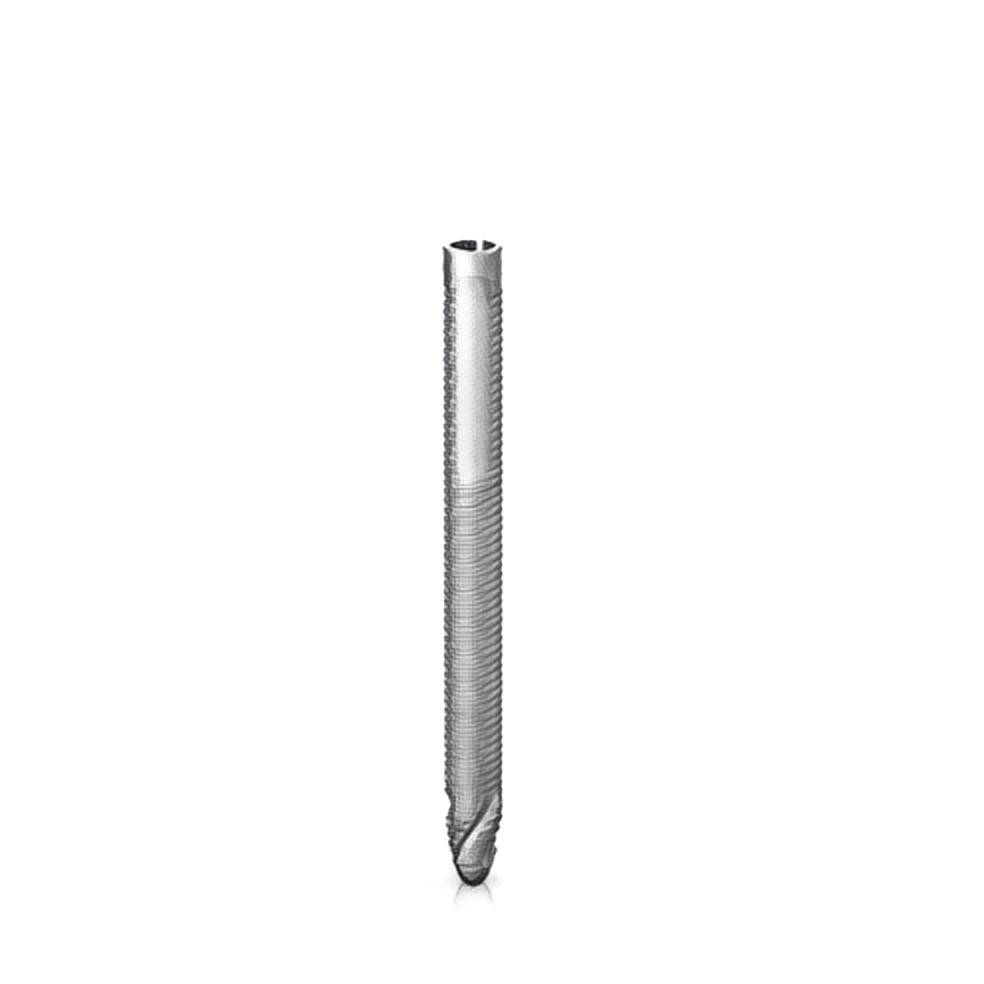
Full-length zygomatic implant for severe maxillary atrophy where conventional implants are not possible. Ten length options from 30 to 55 mm with the landmark Tissue Protect design and Grand Morse® 16° connection for the NeoArch® Quad Zygoma protocol.
| Implant Classification | Full Zygomatic Implant — engages zygomatic cortical bone with full length trajectory |
| Primary Indication | Severe posterior maxillary atrophy — Cawood & Howell Classes IV–VI — where standard implants are not viable |
| Apex Design | Conical apex with spherical self-tapping tip and three helical flutes for secure cortical purchase in dense zygomatic bone |
| Thread Design | Progressive trapezoidal threads — denser pitch at apical cortical zone for maximum primary stability in dense bone |
| Surface Treatment | NeoPoros (SLA) on the osseous-contact zone · smooth machined Tissue Protect surface at cervical extramaxillary path |
| Diameter | Ø 4.0 mm |
| Available Lengths | 30 / 32.5 / 35 / 37.5 / 40 / 42.5 / 45 / 47.5 / 50 / 55 mm (10 options) |
| Connection | Grand Morse® 16° internal conical connection — angled cervical emergence for prosthetic flexibility |
| Compatible Techniques | Intrasinus · Extrasinus · ZAGA 0–4 · Quad Zygoma (4 zygomatic implants) |
| Immediate Loading | Supported when torque ≥ 35 N·cm and ISQ ≥ 65 at both apical and cervical measurements |
| Prosthetic Compatibility | Neodent GM system: MUA 0° / 17° / 30° · Ti-Base · Angled Solution (AS) abutments · digital CAD/CAM workflows |
| System Compatibility | NeoArch® Quad Zygoma protocol · compatible with Neodent NeoArch® guided kits and surgical bars |
| Material | Grade IV commercially pure titanium · cold-worked for superior fatigue resistance |
| Sterility | Sterile, single-use · ethylene oxide sterilization · factory-sealed with lot number and expiry date |
The Zygoma GM offers the widest length range of any zygomatic implant — 10 options allow exact matching to the patient's anatomical trajectory as measured on CBCT.
All lengths in Ø 4.0 mm. Contact us to confirm current stock for specific lengths.
The Neodent Zygoma GM is a full-length zygomatic implant developed to rehabilitate patients with severe maxillary atrophy — the most challenging indication in implantology. Unlike conventional implants that require a minimum bone height of 8–10 mm in the posterior maxilla, the Zygoma GM bypasses the resorbed alveolar ridge entirely and anchors in the dense cortical bone of the zygomatic body.
The implant spans from the crestal ridge across the full maxillary sinus trajectory and terminates in the zygomatic process, which provides reliable, predictable cortical anchorage even when alveolar bone is completely absent. With 10 length options from 30 to 55 mm, surgeons can precisely match the implant length to the patient's anatomy as measured on CBCT, ensuring optimal apical engagement without excess length.
The Grand Morse® 16° connection at the cervical end ensures the same prosthetic platform used across the full Neodent implant portfolio. This means standard MUA abutments (0°, 17°, 30°), Ti-Bases, and NeoArch® bars all connect directly — no proprietary prosthodontic components required.
The Tissue Protect smooth zone at the cervical-transmucosal portion prevents inflammatory infiltration along the extramaxillary path through the sinus mucosa and soft tissue, which is the leading cause of late failures in zygomatic implantology.
In Quad Zygoma cases (4 zygomatic implants), anterior implants are typically 30–40 mm while posterior implants are 45–55 mm. Always plan with CBCT and surgical guide for predictable angulation and emergence point.
The apical zone engages the dense cortical bone of the zygomatic body — typically 3–5 mm of thick cortex — providing primary stability independent of maxillary bone volume.
The same internal conical platform used across the full Neodent GM product family. Full prosthetic compatibility with MUA 0°/17°/30°, Ti-Base, and all Neodent GM components — no proprietary adaptors required.
The cervical portion is machined smooth to prevent bacterial infiltration and soft tissue inflammation along the sinus-transmucosal path. This design feature directly reduces peri-implant mucositis and late infection risk.
Three helical cutting flutes at the spherical apex enable self-cutting engagement in the zygomatic cortex, reducing heat generation and insertion torque spikes while maintaining high primary stability.
Sandblasted + acid-etched (SLA) microporous surface on the osseous-contact zone promotes osseointegration with zygomatic bone. Surface roughness Ra 1.2–2.0 µm — proven in over 15 years of Neodent clinical data.
With 2.5 mm increments from 30 to 55 mm, surgeons can precisely match implant length to the CBCT-measured trajectory. Eliminates the need to "round up" to a non-ideal length, protecting the orbital floor and periorbital structures.
The Zygoma GM is reserved for patients where posterior maxillary implants are not feasible without extensive augmentation.
Cawood & Howell Class V or VI — vertical bone height < 4 mm posterior to canine. Bilateral or unilateral. Avoids the need for bilateral sinus lifts or large-volume iliac crest grafts.
Patients who have undergone failed or complicated sinus lift procedures with insufficient bone formation. The Zygoma GM bypasses the deficient graft site entirely.
The Quad Zygoma protocol (4 zygomatic implants) provides same-day full-arch support without any maxillary bone — delivering a fixed provisional bridge on the day of surgery.
Post-maxillectomy or post-irradiated patients where alveolar bone is absent or unreliable. The zygomatic body is remote from most oral cavity resection margins and generally viable for anchorage.
Patients who decline extensive bone augmentation procedures due to morbidity, cost, or multi-stage treatment timelines. Zygomatic implants offer a graftless, single-stage alternative.
Combined with anterior Neodent Helix GM or Drive GM implants in the premaxilla (if bone is available), the Zygoma GM provides posterior support for a complete fixed full-arch rehabilitation.
The following is a condensed surgical sequence. Full NeoArch® Zygomatic Surgical Protocol manual is available from Neodent. Always refer to the official IFU.
Assess the zygomatic body volume, trajectory angle, sinus anatomy, and orbital floor clearance. Measure implant path length from crestal emergence to anticipated apical cortical purchase. Select implant length with 3–5 mm of apical cortical engagement in the zygomatic body.
Guided Zygoma GM placement via NeoArch® kit is recommended. If freehand, a palatal entry point is marked at the intersection of first molar / second premolar with the zygomaticomaxillary buttress. Mucoperiosteal flap is elevated to expose the lateral wall.
For intrasinus approach: prepare a lateral antrostomy window with a round bur under copious irrigation. Elevate the Schneiderian membrane carefully to visualize the zygomatic process. For extrasinus (ZAGA): the implant body remains external to the sinus — no window required.
Use the Neodent Zygoma GM drill sequence: 2.0 mm pilot → 3.0 mm twist drill → 3.5 mm finishing drill. All drills are used at 800–1,000 rpm with copious external irrigation. Final drilling depth targets 3–5 mm into the zygomatic cortex confirmed by tactile resistance and CBCT-guided depth measurement.
Mount the Zygoma GM on the torque wrench with the dedicated Zygoma driver. Insert at 25–35 rpm. Stop when the Tissue Protect smooth zone reaches the crestal mucosa. Record insertion torque — target ≥ 35 N·cm for immediate loading eligibility. Measure ISQ with resonance frequency analysis.
Connect Multi-Unit Abutments (0°, 17°, or 30°) torqued to 15 N·cm initially. Take impression or intraoral scan for bar fabrication. If ISQ ≥ 65 and torque ≥ 35 N·cm on all implants: load the NeoArch® provisional bar on day of surgery. Patient maintains provisional for 3–4 months before final prosthesis.
At 3–4 months, retorque MUAs to 30 N·cm. Verify osseointegration with ISQ and clinical assessment. Fabricate definitive metal-ceramic or zirconia full-arch bridge. Long-term annual follow-up with periapical X-rays and peri-implant mucosal assessment.
| Component | Torque | Notes |
|---|---|---|
| Implant insertion (target) | ≥ 35 N·cm | Required for immediate loading eligibility |
| Implant insertion (maximum) | 70 N·cm | Do not exceed — risk of over-compression in cortex |
| MUA seating (initial) | 15 N·cm | At placement, day of surgery |
| MUA final torque | 30 N·cm | After osseointegration confirmed at 3–4 months |
| Prosthetic screws | 10–15 N·cm | Per prosthetic component IFU |
Contact us via WhatsApp for zygomatic implant pricing, length availability, surgical kit consultation, and NeoArch® protocol support.