Neodent — Grand Morse Family · Extended Length

Neodent /
GM Long

Maximum bone anchorage through extended length design. For cases demanding exceptional primary and secondary stability where standard lengths are anatomically insufficient — nasal floor, pterygoid, and atrophic ridge applications.

Extra Length 16–20 mm Grand Morse® 16° Nasal Floor Pterygoid Region Atrophic Maxilla Bicortical Anchorage 60 N.cm
Pricing
Request Quote
Contact us for GM Long pricing — Acqua or NeoPoros
Product

Full Product Specifications

Complete technical data for the Neodent GM Long extended-length implant system. Current as of the latest Neodent product documentation.

ParameterSpecification
Implant TypeExtended length (16–20 mm) — tapered body, progressive thread design
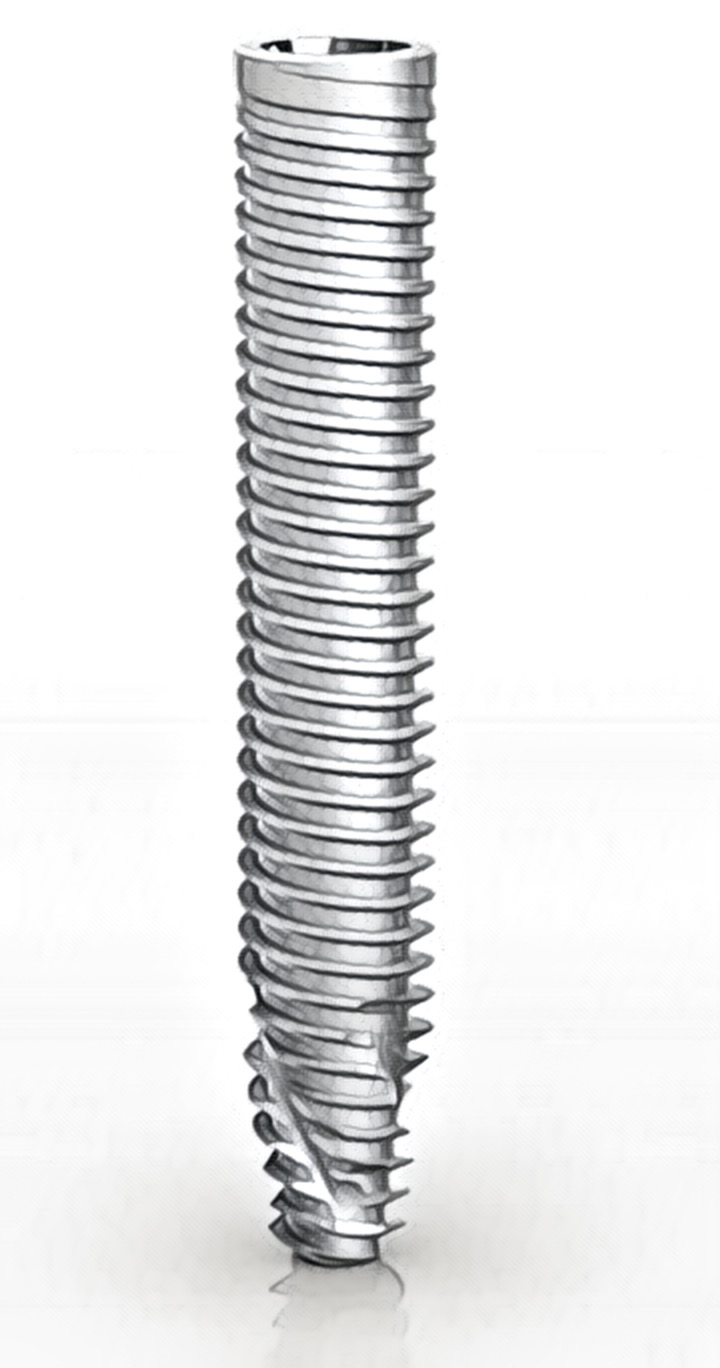
Thread DesignProgressive hybrid: compressive square-type threads (coronal zone) + self-tapping V-threads (apical zone)
Thread Zone FunctionCoronal: bone compression and stability · Apical: self-tapping engagement of cortical plates
Connection TypeGrand Morse® 16° internal cone (Morse taper)
Platform DesignPlatform switching — prosthetic platform narrower than implant platform
Surface TreatmentAcqua (hydrophilic, nitrogen-sealed) · NeoPoros (SLA equivalent)
Available Diameters3.75 mm · 4.3 mm
Available Lengths16 mm · 18 mm · 20 mm
Primary IndicationAtrophic ridges with adequate height, nasal floor bicortical anchorage, pterygoid/pterygomaxillary region
Secondary IndicationNarrow ridges with good vertical height, full-arch rehabilitation without posterior sinus grafting
Maximum Insertion Torque60 N.cm rated — target ≥35 N.cm for immediate loading protocols
Diameter LimitationAvailable in 3.75 and 4.3 mm only — no 5.0 mm in the Long series
Guided SurgeryStrongly recommended — CBCT mandatory for proximity to anatomical structures
MaterialGrade IV commercially pure titanium (cpTi) — TiO₂ surface oxide layer
CompatibilityAll Neodent Grand Morse prosthetic components — MUAs (17° and 30°), Ti-Bases, straight abutments
RegulatoryANVISA registered · CE marked · FDA 510(k) cleared

What is the GM Long?

The Neodent GM Long addresses clinical scenarios where bone height compensates for reduced width, or where the clinician must engage specific anatomical structures to achieve anchorage that would be impossible with standard-length implants. When a patient presents with a narrow but tall alveolar ridge, or when the surgical plan requires engagement of the nasal floor for additional coronal anchorage in an atrophic anterior maxilla, standard 7–17 mm implants simply cannot reach the required structures. The GM Long's extended dimensions — available in 16, 18, and 20 mm — allow engagement of multiple cortical plates simultaneously, achieving bicortical anchorage that dramatically increases both primary stability at placement and secondary stability during osseointegration.

The GM Long's thread design reflects the specific demands of extended-length placement. The coronal portion of the implant body uses compressive threads — similar in philosophy to the Drive GM's approach — which densify the crestal trabecular bone and generate lateral stability at the most critical zone for soft tissue support and marginal bone maintenance. The apical portion transitions to self-tapping V-threads designed specifically for engaging cortical bone at depth: the nasal floor cortex, the palatal cortex in pterygoid placement, or the apical cortical plate in very long sites. This progressive hybrid design gives the surgeon the compression benefit where it matters most (the crest) and the cortical-cutting efficiency where it is needed most (the apex).

One of the most compelling applications for the GM Long is the pterygomaxillary implant — a specialized posterior maxillary technique used as an alternative to conventional sinus grafting in full-arch rehabilitation cases. In All-on-4 and All-on-6 variants, pterygoid implants positioned into the pterygoid process and pyramidal process of the palatine bone allow the clinician to extend a fixed prosthesis to the second molar region without any sinus augmentation procedure. The GM Long's 20 mm option is the implant of choice for this application, as it achieves sufficient length to traverse the tuberosity and reach the pterygoid process with reliable bicortical engagement. This technique is technically demanding but can eliminate sinus grafting entirely in appropriately selected cases.

The GM Long uses the same Grand Morse 16° internal cone connection as the entire GM family, preserving full prosthetic interchangeability. In full-arch cases that combine GM Long pterygoid implants with standard-length Drive GM or Helix GM anterior implants, the clinician works with a single prosthetic component inventory and a single connection philosophy throughout the restoration. The cold-weld Morse taper achieves the same friction seal, the same zero-microgap interface, and the same platform switching crestal bone protection regardless of whether the underlying implant is a 7 mm Helix Short or a 20 mm GM Long.
GM Long at a Glance
  • Available in 16, 18, and 20 mm — extends access to nasal floor, pterygoid, and multi-cortical anchorage zones
  • Progressive hybrid threads: compressive coronal + self-tapping apical — optimized for the entire length
  • Primary use: pterygomaxillary implants, nasal floor bicortical anchorage, atrophic ridge management
  • Eliminates posterior sinus grafting in selected full-arch cases when placed in the pterygoid region
  • CBCT planning and guided surgery strongly recommended — proximity to critical structures requires precision
  • Grand Morse 16° connection: same cold-weld seal and full prosthetic interchangeability as the entire GM family
  • Available in 3.75 and 4.3 mm diameter only — no 5.0 mm in the Long series
  • Immediate loading capable when insertion torque ≥35 N.cm is achieved

Why Clinicians Choose the GM Long

Six clinical and engineering advantages that make the GM Long the solution of choice when standard implant lengths are insufficient.

📏
Extended Length — 16 to 20 mm
Available in 16, 18, and 20 mm, the GM Long reaches anatomical structures that are completely inaccessible to standard-length implants. This extended reach enables bicortical anchorage through multiple bone plates simultaneously — multiplying both primary stability and long-term secondary stability at a single fixture.
🔀
Progressive Hybrid Thread Design
The coronal thread zone uses compressive mechanics to densify crestal bone and generate marginal stability — critical for tissue architecture support. The apical zone transitions to self-tapping threads optimized for engaging cortical bone plates at depth. This dual-zone engineering matches thread behavior to the actual bone type encountered at each level.
🦴
Bicortical Anchorage Capability
By engaging two or more cortical plates — the alveolar crest and the nasal floor, or the alveolar crest and the pterygoid process — the GM Long achieves stability values that cannot be replicated by implants that rely on a single cortical engagement point. This is the mechanical foundation of immediate loading in the atrophic maxilla.
🏛️
Pterygomaxillary Implant Specialist
The 20 mm GM Long is the Neodent solution for pterygoid placement — a technique that uses the dense pterygoid process bone for posterior anchorage in full-arch rehabilitations. Used in All-on-4 and All-on-6 protocols, pterygoid implants eliminate the need for posterior sinus augmentation in suitable cases, reducing total treatment time and cost significantly.
🔒
Grand Morse® 16° Internal Cone
The deep Morse taper connection delivers the same cold-weld friction seal as every other implant in the GM family. In full-arch cases that combine GM Long with standard Drive GM or Helix GM implants, the clinician works with a single connection system and a single prosthetic inventory — simplifying laboratory workflow and eliminating component compatibility concerns.
🎯
Guided Surgery Compatible
Precise placement near the nasal floor, sinus walls, and pterygoid process requires sub-millimeter accuracy that freehand surgery cannot reliably achieve. The GM Long is fully compatible with digital implant planning software and surgical guide systems — making CBCT-based guided surgery the recommended approach for every GM Long case, not an optional upgrade.

Where the GM Long is Used

The GM Long is purpose-built for four specific anatomical and clinical scenarios where standard-length implants cannot achieve adequate anchorage.

Nasal Floor Anchorage Anterior Maxilla

In the severely atrophic anterior maxilla, the distance from the alveolar crest to the nasal floor may be less than 10 mm. The GM Long (16–18 mm) intentionally perforates and engages the nasal floor cortex, achieving bicortical anchorage that can provide ISQ values 15–20 points higher than monocortical placement in the same site. This technique requires precise CBCT planning and ideally guided surgery to control the angle of perforation. The nasal floor perforation is a known, accepted technique that patients tolerate well and that heals without complication in the vast majority of cases.

Pterygomaxillary Implant All-on-4 / All-on-6

The pterygoid region contains dense bone at the junction of the pterygoid process of the sphenoid bone and the pyramidal process of the palatine bone. Implants placed into this region — typically angled distally 45° and superiorly 10–15° — engage this dense bone to provide posterior anchorage in full-arch cases. The 20 mm GM Long is the standard choice for pterygoid placement, as its length allows traversal of the tuberosity and engagement of the pterygoid process cortical bone. This eliminates posterior sinus grafting and enables immediate loading of full-arch prostheses.

Narrow Ridge — Tall Vertical Height Atrophic Ridge

When a patient presents with a narrow alveolar ridge (4.0–5.0 mm width) that has good vertical height, the GM Long allows maximum use of the available bone volume. In cases where a 5.0 mm diameter implant is contraindicated due to inadequate ridge width, but the ridge has 18–20 mm of vertical height, the GM Long in 3.75 or 4.3 mm diameter provides a surface area of bone-to-implant contact that compensates for the narrower diameter — achieving stability values comparable to wider short implants through length rather than width.

Full-Arch Rehabilitation Anchorage Immediate Loading

In complex full-arch cases, the GM Long is often used in combination with standard-length GM implants to create a quadrant of high-stability anchor points. Posterior GM Long implants placed at the pterygoid region or tuberosity, combined with anterior Drive GM or Helix GM implants, allow the clinician to distribute the full-arch prosthetic load across a broad anatomical base. This combination approach is the foundation of graft-free full-arch rehabilitation in the atrophic maxilla, reducing total treatment time from 12–18 months (with grafting) to a single surgical session with immediate loading.

Clinical Indications & Case Selection

The GM Long is a specialized implant that demands careful case selection. Understand the ideal patient profile and the absolute contraindications before planning a case.

Indications Use GM Long
  • Atrophic posterior maxilla where posterior sinus grafting is to be avoided — pterygoid approach with 20 mm GM Long
  • Anterior maxilla with <10 mm alveolar height — nasal floor bicortical anchorage with 16 or 18 mm
  • Narrow alveolar ridges (4.0–5.0 mm) with good vertical height — length compensates for reduced diameter
  • Full-arch rehabilitation requiring maximum posterior anchorage without sinus augmentation
  • All-on-4 and All-on-6 variants in the atrophic maxilla using pterygomaxillary technique
  • Sites requiring bicortical engagement to achieve ISQ values sufficient for immediate loading
  • Cases where the surgeon is experienced in pterygoid and nasal floor anatomy and guided surgery protocols
Contraindications Choose Alternative
  • Cases requiring 5.0 mm diameter — GM Long available only in 3.75 and 4.3 mm
  • Inadequate vertical bone height below critical structures — CBCT must confirm safe trajectory before planning
  • Active chronic sinusitis or significant sinus pathology — consult ENT specialist before nasal floor engagement
  • Surgeons without experience in pterygoid implant technique — this is an advanced procedure requiring specific training
  • Cases without CBCT — freehand placement near nasal floor or pterygoid structures is not acceptable
  • Insufficient bone density in the pterygoid region (rare but must be confirmed on CBCT before planning)
  • Standard sites with adequate bone volume — use Drive GM, Helix GM, or Titamax GM instead; GM Long is a specialized solution

Surgical Protocol Notes

Critical protocol points for GM Long placement. Due to proximity to critical anatomical structures, this implant demands more rigorous pre-surgical planning than standard sites. Always follow the official Neodent surgical manual and relevant advanced surgical training protocols.

1
CBCT Planning — Mandatory, Not Optional
CBCT is an absolute prerequisite for every GM Long case — not a recommended option. Identify the trajectory, depth, and clearance from all critical anatomical structures: nasal floor (anterior cases), sinus walls (tuberosity cases), pterygoid process contour and medullary canal (pterygoid cases), and inferior alveolar nerve in mandibular long cases. Measure the available bone along the planned implant axis at 1 mm intervals. Use implant planning software to simulate the final position in three dimensions before committing to a guide design.
2
Guided Surgery — Strongly Recommended
Surgical guide fabrication from CBCT data is strongly recommended for all GM Long cases and considered mandatory for pterygoid placement. The guide controls the entry point, angulation in both the buccolingual and mesiodistal axes, and depth — all three critical dimensions that cannot be reliably controlled freehand when working near the nasal floor or pterygoid structures. Use a bone-supported or tooth-supported guide with sleeve guidance for maximum positional accuracy throughout the full drilling depth.
3
Extended Drill Kit — Depth Access
Standard drill lengths are insufficient for GM Long placement. Verify that your surgical kit includes the appropriate extended drill extensions for 16–20 mm depth. For pterygoid cases, the drilling trajectory (angled distally 45° and superiorly 10–15°) requires specific drill orientation awareness — the guide sleeve must accommodate the angled approach. Irrigation management is critical: ensure coolant reaches the full depth of the osteotomy throughout the entire drilling sequence, particularly in the dense pterygoid bone where heat generation is highest.
4
Nasal Floor Protocol — Intentional Bicortical Engagement
For anterior maxilla nasal floor cases: the perforation of the nasal floor cortex is intentional and planned. Drill through the nasal floor with the appropriate long drill at 800–1000 RPM with irrigation, engaging 2–3 mm of nasal floor cortex. The patient may feel nasal pressure during drilling — this is normal. Insert the GM Long until the apex just engages the nasal floor cortex. The bicortical "lock" you feel at final insertion is the engagement you are targeting — this represents your primary stability anchor point. Do not force through resistance beyond planned depth.
5
Pterygoid Protocol — Bone Density and Trajectory
For pterygoid placement: begin drilling at the distobuccal aspect of the maxillary tuberosity at the planned angulation (typically 45° distal, 10–15° upward in the sagittal plane). The drilling will traverse three distinct bone zones — the soft tuberosity, the denser pyramidal process of the palatine bone, and the dense pterygoid process of the sphenoid. Resistance typically increases significantly in the final 6–8 mm of drilling. Insertion torque in the pterygoid zone commonly reaches 35–60 N.cm from pterygoid bone engagement alone — confirming successful bicortical anchorage and supporting immediate loading.
6
Loading Protocol and RFA Verification
Target insertion torque for immediate loading: ≥35 N.cm — confirmed in the majority of GM Long cases due to bicortical engagement. Use RFA (ISQ measurement) as a secondary confirmation: ISQ ≥65 supports immediate loading in all GM Long applications. For full-arch immediate loading (All-on-4/All-on-6): connect MUA at 30° (distal implants) and 17° or straight (anterior implants) using Neodent GM MUA components. Screw torque: 32 N.cm for MUAs. Deliver provisional prosthesis with careful occlusal management — avoid cantilever loading and posterior occlusal contacts in the first 4 weeks.
Safety Note — Advanced Technique

GM Long implants placed near the nasal floor, sinus, or pterygoid region involve proximity to critical anatomical structures. These are advanced surgical techniques. Surgeons new to pterygoid or nasal floor implant placement should complete dedicated hands-on training with anatomical specimens and experienced mentors before performing these procedures clinically. Inaccurate placement can result in sinus perforation, nasal floor damage, or pterygoid vascular injury. CBCT planning and surgical guide use are not optional extras — they are the minimum standard of care for these cases.

Clinical Tip — The Feel of Pterygoid Engagement

Experienced pterygoid implant surgeons describe a distinctive three-phase resistance profile: soft resistance through the tuberosity, moderate resistance through the pyramidal process, and then a sudden firm resistance increase when the apex enters the pterygoid process cortical bone. This final resistance surge is your confirmation of anatomical success. If you do not feel this progressive resistance increase and the implant seats too easily to full depth, the apex may not have engaged the pterygoid cortex — re-evaluate with CBCT or fluoroscopy before loading the implant.

Available Sizes & Configurations

The GM Long series is available in a focused range of diameters and extended lengths. Note: the 5.0 mm diameter is not available in this series.

Diameter ↓ / Length → 16 mm 18 mm 20 mm
3.75 mm
4.3 mm
5.0 mm

GM Long available in Acqua (hydrophilic) and NeoPoros (SLA) surfaces. 5.0 mm diameter not available in the Long series — use Drive GM or Helix GM for 5.0 mm requirements. Contact us for current pricing.

GM Long — Common Questions

Answers to the most common clinical questions about GM Long placement, pterygoid technique, and nasal floor protocols.

Ready to Plan a GM Long Case?

Contact us for GM Long pricing, availability, and technical support. Our team can assist with product selection for complex anatomical cases.

Request GM Long Quote on WhatsApp