Neodent — Grand Morse Family

Neodent /
Drive GM

Engineered for maximum primary stability in compromised bone. Square-thread body with reverse cutting chambers compresses and engages bone simultaneously — delivering immediate-loading confidence where V-thread implants fall short.

Tapered Design Grand Morse® 16° Square Threads Reverse Cutting Chambers Bone Types III–IV 60 N.cm Immediate Loading
Pricing
From Contact Us
Per unit — Acqua or NeoPoros surface
Product

Full Product Specifications

Complete technical data for the Neodent Drive GM tapered implant system. All specifications are current as of the latest Neodent product documentation.

Parameter Specification
Implant TypeFull Tapered (conical body)
Thread DesignSquare-shape profile · Double threaded (dual lead)
Cutting ChambersReverse cutting chambers distributed across the full implant body (not apex-only)
Apex DesignRounded apex with sharp self-cutting edge
Connection TypeGrand Morse® 16° internal cone (Morse taper)
Platform DesignPlatform switching — prosthetic platform narrower than implant platform
Surface TreatmentAcqua (hydrophilic) — recommended for immediate loading · NeoPoros (SLA equivalent) — cost-effective option
Available Diameters3.75 mm · 4.3 mm · 5.0 mm
Available Lengths7 · 8 · 9 · 11 · 13 · 15 · 17 mm
Primary IndicationBone Types III and IV (soft/porous bone) — posterior maxilla, atrophic ridges
Secondary IndicationWorks effectively in Bone Types I and II with appropriate protocol adjustment
Maximum Insertion Torque60 N.cm rated — 35+ N.cm recommended for immediate loading
MaterialGrade IV commercially pure titanium (cpTi) — TiO₂ surface oxide layer
CompatibilityAll Neodent Grand Morse prosthetic components, MUAs, Ti-Bases, impression copings
SterilizationPre-sterilized, gamma-irradiated, single use
RegulatoryANVISA registered · CE marked · FDA 510(k) cleared

What is the Drive GM?

The Neodent Drive GM was developed specifically to address the most clinically challenging implant scenarios — soft, porous bone classified as Types III and IV — where achieving reliable primary stability with conventional implant designs is notoriously difficult. Bone Type IV, most commonly found in the posterior maxilla and in older patients with reduced bone density, presents with a thin cortical shell and a coarse, low-density trabecular core. In these conditions, standard V-thread implants often compress poorly, spin, or fail to generate the insertion torque required for immediate or early loading protocols.

The Drive GM's defining engineering innovation is its square-thread geometry. Unlike V-shaped threads, which are designed to cut through bone as the implant advances, square threads interact with bone through lateral compression. As the Drive GM rotates into the osteotomy, its flat thread faces push outward against the bone walls, consolidating and densifying the trabecular structure around the entire implant body. This bone compression effect directly increases bone-to-implant contact (BIC) and insertion torque, often delivering ISQ values 10 to 15 points higher than V-thread alternatives in equivalent Type III/IV bone sites.

Complementing the square threads is a network of reverse cutting chambers distributed throughout the full implant body — not merely at the apex as seen in many competing designs. These chambers serve a dual function: they evacuate excess bone debris during insertion, preventing dangerous hydraulic pressure buildup within the osteotomy, and they provide discrete zones where bone grows into the implant body during osseointegration. This combination of features makes the Drive GM uniquely effective for immediate loading protocols in compromised bone, a scenario where predictability is paramount.

At its coronal connection, the Drive GM employs the Grand Morse 16° internal cone — Neodent's hallmark connection architecture. The deep Morse taper creates a cold-weld friction seal between implant and abutment, virtually eliminating micromovement at the implant-abutment interface. Combined with platform switching geometry, this connection design promotes crestal bone maintenance over the long term, preserving the biologic width and protecting the peri-implant tissue architecture even in cases with limited initial bone volume.
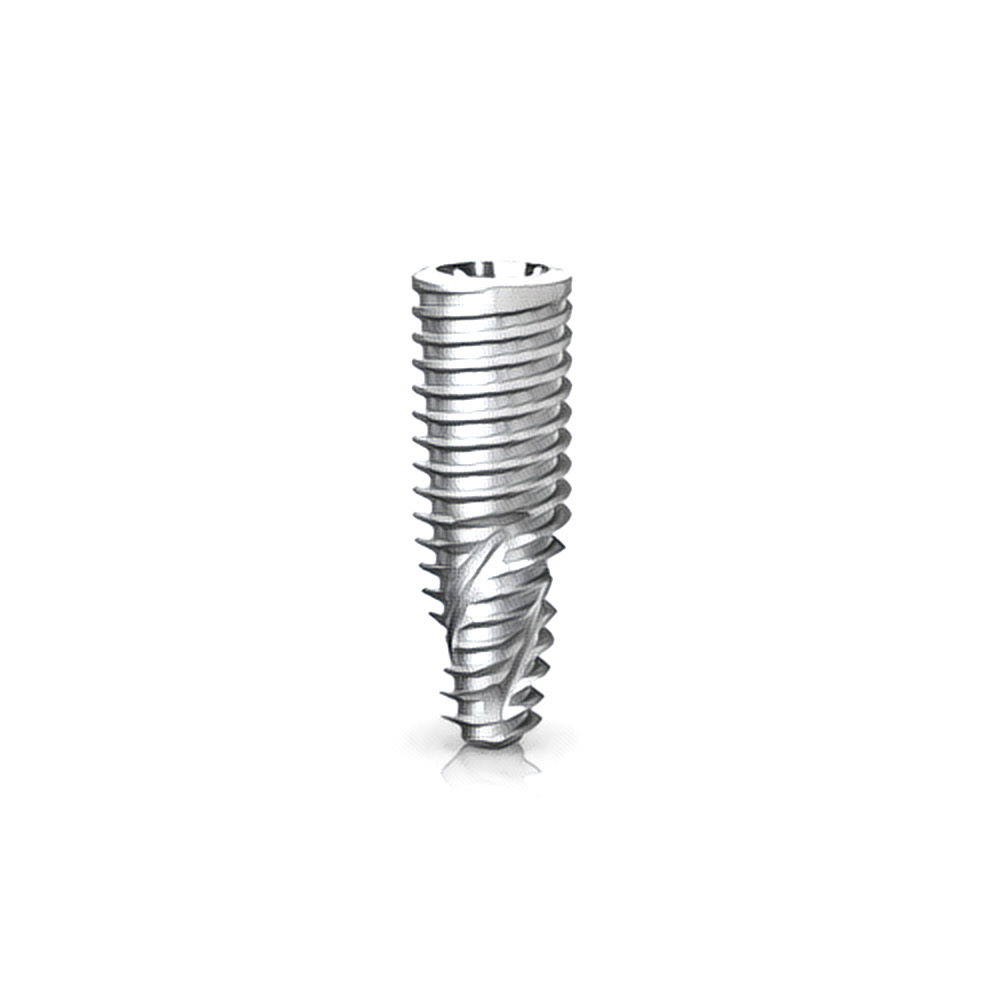
Design Innovations at a Glance
  • Square-profile threads compress bone laterally rather than cutting through it — ideal for soft trabecular structures
  • Reverse cutting chambers span the entire implant body, not just the apex, for uniform bone management
  • Full-taper geometry creates a "wedge" effect, dramatically increasing contact area against bone walls
  • Grand Morse 16° cone achieves cold-weld friction seal — no microgap, no micromovement
  • Platform switching design preserves crestal bone height and biologic width long-term
  • Acqua surface enables 3-week osseointegration with hydrophilic wettability enhancement
  • Double-threaded lead design reduces insertion time and rotations required
  • Rounded apex with cutting edge allows controlled bone compression at the apical seat

Why Clinicians Choose the Drive GM

Six clinically meaningful design features that translate directly into better outcomes in compromised bone scenarios.

Square Thread Architecture
The flat-faced square profile compresses bone laterally as the implant advances, densifying the trabecular network and increasing bone-to-implant contact. In Type IV bone, this can mean the difference between a stable implant and a spinner that must be removed.
🔄
Full-Body Reverse Cutting Chambers
Positioned throughout the entire implant body (not just the apex), these chambers continuously manage bone debris during insertion, preventing dangerous over-pressure buildup. They also serve as bone ingrowth anchors during osseointegration, enhancing secondary stability.
📐
Full Tapered Geometry
The conical body creates a wedge effect as it seats, simultaneously engaging the lateral bone walls along the full implant length. This multi-point engagement is particularly effective in wide osteotomies and post-extraction sockets where bone contact is not perfectly uniform.
🔒
Grand Morse® 16° Internal Cone
The deep internal Morse taper creates a metal-to-metal friction seal that self-locks under occlusal loading. This eliminates the micromovement and microgap of conventional hex connections, protecting crestal bone from stress and bacterial infiltration at the interface.
💧
Acqua Hydrophilic Surface
The Acqua surface maintains a hydrophilic state through nitrogen-packaged storage, dramatically improving protein adsorption and cell attachment in the first critical hours after placement. This translates to faster, more reliable osseointegration — particularly valuable in compromised bone quality.
🏛️
Platform Switching
The prosthetic platform diameter is narrower than the implant diameter, shifting the microgap medially and away from the bone crest. This distributes stress more favorably and consistently shows superior crestal bone preservation versus conventional same-diameter platforms across long-term clinical studies.

Clinical Indications & Case Selection

The Drive GM excels in specific clinical scenarios. Understanding when to choose it — and when to choose a different design — is critical for predictable outcomes.

Indications Use Drive GM
  • Type III and IV bone quality — posterior maxilla, atrophic ridges, older patients with reduced bone density
  • Immediate implant placement in post-extraction sockets with soft bone walls
  • Immediate loading protocols in compromised bone where maximum primary stability is required
  • Patients with known or suspected low bone mineral density or osteoporosis risk
  • Cases requiring insertion torques ≥35 N.cm in bone that would not support this with V-thread designs
  • Wide osteotomies where wedge compression along the full body improves stability
  • Healed ridge sites in the posterior maxilla where sinus floor is not involved
  • Situations where early loading (3–4 weeks) is clinically necessary
Contraindications Choose Alternative
  • Very thin narrow ridges (<4 mm buccolingual width) — use Helix Narrow or CM Slim instead for ridge preservation
  • Extremely dense D1 cortical bone (mandibular symphysis) — use Titamax GM; over-torquing risk with Drive GM without tapping
  • Sites requiring extra length (16–20 mm) — use GM Long instead; Drive GM max length is 17 mm
  • Active uncontrolled periodontal disease in adjacent teeth
  • Inadequate bone volume (<1 mm of bone around implant) without simultaneous GBR
  • Patients with bisphosphonate therapy (IV) — relative contraindication requiring specialist assessment
  • Heavy smokers with Type IV bone — primary stability may be insufficient even with Drive GM compression

Surgical Protocol Notes

Key protocol considerations for Drive GM placement. Always refer to the official Neodent surgical manual for complete step-by-step guidance.

1
Pre-Surgical Assessment
CBCT analysis to confirm bone quality and quantity. Identify bone type from HU values (Type III: 350–850 HU; Type IV: <350 HU). Plan undersized osteotomy depth — Drive GM requires preparation 1 drill size below final implant diameter in soft bone. Confirm crestal width ≥4 mm and presence of adequate keratinized tissue.
2
Osteotomy Preparation — Undersized Protocol
In Type III/IV bone: use undersized drilling sequence (stop 1 drill diameter below planned implant diameter). This is critical — the Drive GM's compression threads require resistance to compress effectively. In Type I/II bone: follow standard drill sequence. Speed: 800–1200 RPM with copious external irrigation throughout. Use sharp, fresh drills — dull drills generate heat and damage the bone structure the Drive GM needs to compress.
3
Bone Tapping — Selective Use
In Type III and IV bone: bone tap is NOT used. The Drive GM's reverse cutting chambers handle bone management during insertion. In Type I cortical bone: if inserting the Drive GM into dense bone (by choice or anatomical necessity), use a bone tap to prevent dangerously high insertion torques that could microfracture the cortical plate. Skipping the tap in D1 bone risks overtorque and early bone resorption.
4
Implant Insertion
Begin with motor at 15–25 RPM — slow speed is critical for precision and torque feel. Use torque-controlled handpiece set to maximum 45 N.cm to prevent accidental over-torquing in very soft D4 bone. When resistance increases (typically in the final 2–3 mm of seating), switch to manual torque wrench for controlled final seating. Feel for the torque increase that indicates bone engagement — this is your primary stability confirmation.
5
Torque Assessment & Loading Decision
Target insertion torque for immediate loading: ≥35 N.cm. For early loading (3–4 weeks): ≥25 N.cm is acceptable. Conventional loading: any stable insertion torque. In very soft D4 bone, do NOT pursue maximum torque — stop at 45–50 N.cm maximum to avoid microfracture and ischemic necrosis. Use RFA (ISQ measurement) if available: ISQ ≥65 supports immediate loading; ISQ 55–64 supports early loading; ISQ <55 requires conventional healing.
6
Prosthetic Connection
For immediate loading: connect MUA or straight abutment with Neodent GM prosthetic components only. The Grand Morse 16° connection achieves cold-weld seal — abutment screw torque: 32 N.cm (MUA) or as specified by prosthetic protocol. For conventional or early loading: place healing cap and close with suture. Submerged healing recommended in ISQ <65 or when bone grafting is simultaneous.
Clinical Tip — The "Feel" of Drive GM Insertion

Experienced Drive GM users describe a distinctive resistance build-up during insertion compared to V-thread implants. In Type III/IV bone, you should feel progressive resistance increasing from mid-body to final seating — this resistance IS the bone being compressed and indicates the square threads are working as designed. If insertion is completely free with no resistance increase, the osteotomy may be oversized or the bone may be D4-extreme — reconsider your loading protocol and consider grafting at time of placement.

Available Sizes & Configurations

All available diameter × length combinations for the Neodent Drive GM. Check marks indicate available configurations for both Acqua and NeoPoros surfaces.

Diameter ↓ / Length → 7 mm 8 mm 9 mm 11 mm 13 mm 15 mm 17 mm
3.75 mm
4.3 mm
5.0 mm

All configurations available in both Acqua (hydrophilic) and NeoPoros (SLA) surface treatments. Contact us for pricing on specific configurations.

Drive GM — Common Questions

Answers to the questions clinicians ask most often about the Drive GM before and after their first cases.

Ready to Order Drive GM?

Get a personalized quote with current pricing, availability, and volume discounts. Our team responds within 2 hours during business hours.

Request Drive GM Quote on WhatsApp