SLActive® · Roxolid® · CrossFit® Connection
The Bone Level Cylindrical implant combines a cylindrical body design with proven CrossFit® connection and SLActive® surface — achieving predictable osseointegration in 3–4 weeks. Ideal for standardized protocols and guided surgery workflows. Built from Roxolid® titanium-zirconium alloy.
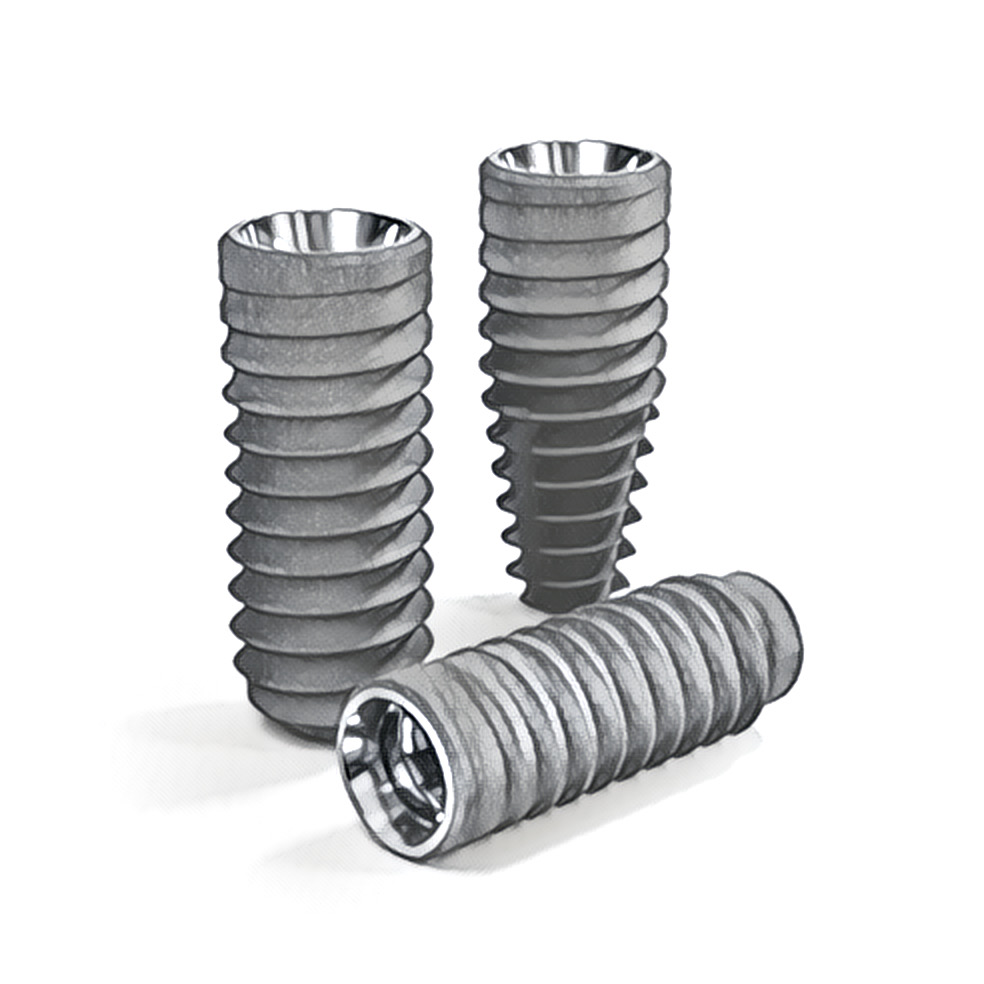
Every element of the BLC is engineered for superior clinical outcomes — from alloy composition to surface chemistry.
SLActive® is a hydrophilic evolution of the classic SLA® surface. The implant undergoes sandblasting with large-grit corundum followed by acid-etching, then is stored in isotonic NaCl solution to preserve surface reactivity. The result is a contact angle of <5° — almost perfectly wettable — compared to ~140° for conventional SLA. This dramatically accelerates protein adsorption and cell attachment, compressing the osseointegration timeline to 3–4 weeks versus 6–8 weeks with standard SLA.
Roxolid® is Straumann's proprietary titanium-zirconium (TiZr) alloy, containing approximately 13–17% zirconium. This binary alloy achieves 15% greater tensile strength than commercially pure titanium (Grade 4), without compromising biocompatibility or osseointegration. The enhanced mechanical properties allow clinically confident use at narrow diameters (Ø 2.9–3.3 mm) in sites with reduced bone volume, minimizing the need for augmentation.
Four defining features that make the BLC the implant of choice for demanding bone situations.
The progressive taper at the implant body creates a compression force in the surrounding bone during insertion, maximizing primary stability — particularly important in soft (Type III–IV) bone and fresh extraction sockets.
SLActive® surface reduces healing time to 3–4 weeks versus the traditional 6–8 weeks, supporting earlier loading protocols and reducing overall treatment time for patients.
The conical CrossFit® internal connection provides a 15° Morse taper seal. Available in NC (Narrow CrossFit, Ø3.3 mm implants) and RC (Regular CrossFit, Ø4.1 and Ø4.8 mm), offering extensive prosthetic versatility.
From Ø 2.9 mm SC to Ø 4.8 mm RC — the widest range in the BL family — enabling treatment of narrow ridges, laterals, and mandibular incisors without compromising mechanical integrity, thanks to Roxolid® alloy.
Complete clinical and material specifications for the Straumann BLC system.
| Parameter | Specification |
|---|---|
| Full Name | Straumann® Bone Level Cylindrical (BLC) Implant |
| Material | Roxolid® — Titanium-Zirconium (TiZr) alloy, ~13–17% Zr |
| Surface Options | SLActive® (hydrophilic, primary) · SLA® (standard, also available) |
| Connection Type | CrossFit® internal conical (15° Morse taper) |
| Connection Variants | SC (Small CrossFit, Ø2.9mm) · NC (Narrow CrossFit, Ø3.3mm) · RC (Regular CrossFit, Ø4.1 & Ø4.8mm) |
| Available Diameters | Ø 2.9 mm · Ø 3.3 mm · Ø 4.1 mm · Ø 4.8 mm |
| Available Lengths | 6 · 8 · 10 · 12 · 14 · 16 · 18 mm (varies by diameter) |
| Design | Bone Level Cylindrical — tapered body, self-tapping, apical flutes |
| Osseointegration Time | 3–4 weeks (SLActive®) · 6–8 weeks (SLA®) |
| Prosthetic System | Variobase® Ti bases · Anatomic abutments · Healing abutments · Impression copings |
| Indications | Single tooth · Partial edentulism · Full arch · Narrow ridges · Immediate placement |
| Sterilization | Sterile, single-use · Gamma-irradiated |
All diameter and length combinations available for the Straumann BLC. Select your configuration and request a quote.
The BLC CrossFit® connection is compatible with a comprehensive prosthetic portfolio for all clinical scenarios.
Universal titanium bases for CAD/CAM crowns, bridges, and hybrid restorations. Available in NC and RC connection heights.
Pre-angled and straight anatomic abutments for cemented or screw-retained restorations. Customizable emergence profile.
Contoured healing abutments that shape ideal peri-implant soft tissue architecture during the osseointegration phase.
Open-tray and closed-tray impression copings for conventional and digital workflows, compatible with major laboratory scanners.